How to Apply for GST Registration as a Casual Taxable Person
Learn how to apply for GST registration as a casual taxable person step-by-step. Discover advance tax rules, extension processes, and expert compliance tips.
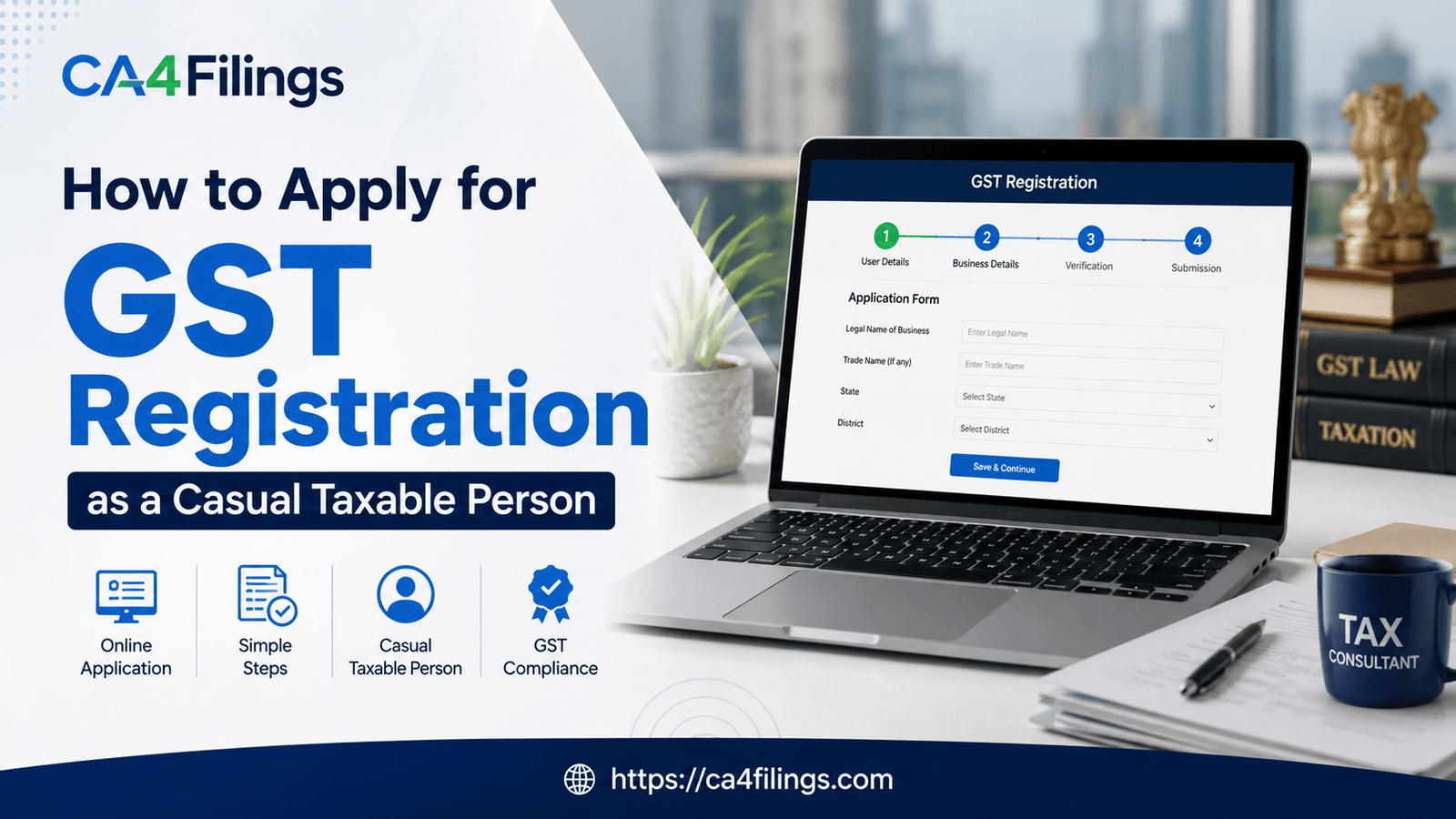
Imagine you run a successful designer boutique in Mumbai. You get a golden opportunity to showcase your collection at a massive 15-day premium lifestyle exhibition in New Delhi. The footfall is expected to be huge, and your sales could skyrocket.
However, there is a legal catch. You do not have a registered office, showroom, or godown in Delhi. Can you just pack your bags, set up a stall, and start selling?
Under the Indian tax ecosystem, the answer is a strict no. To legally sell your goods or services in a state where you do not have a fixed place of business, you must register as a Casual Taxable Person (CTP).
Getting your business compliant doesn't have to be a headache. Whether you need a temporary setup for an event or standard, permanent GST Registration, planning your tax compliance ahead of time ensures you avoid heavy penalties and run your business seamlessly.
In this comprehensive guide, we will break down exactly how to apply for GST registration as a casual taxable person, who needs it, the documents required, and the compliance rules you must follow.
Who is a Casual Taxable Person (CTP) under GST?
According to Section 2(20) of the CGST Act, a Casual Taxable Person is anyone who occasionally undertakes transactions involving the supply of goods or services (or both) in the course of business, in a State or Union Territory where they do not have a fixed place of business.
Whether you are acting as a principal, an agent, or in any other capacity, you fall under this definition if you are operating dynamically across state lines for a short window.
The Major Catch: No Threshold Limit
For regular businesses, the government provides a threshold limit (annual turnover up to ₹40 Lakhs for goods and ₹20 Lakhs for services in most states) before registration becomes mandatory.
Important Rule: There is zero threshold limit for a Casual Taxable Person. Even if your estimated sales at a 3-day exhibition are just ₹5,000, you are legally required to obtain a temporary registration.
Key Features of CTP Registration
Before exploring how to apply for GST registration as a casual taxable person, you must understand how this registration differs from a regular one:
Advance Tax Deposit: You cannot get your hands on a CTP registration certificate without paying your estimated GST liability in advance.
Fixed Validity: The registration is not perpetual. It is valid only for the period specified in the application or 90 days, whichever is earlier.
Strict Timeline: You must apply at least 5 days prior to the commencement of your business or event.
Step-by-Step Guide: How to Apply for GST Registration as a Casual Taxable Person
The process is completed entirely online through the common GST Portal. The overall journey is divided into two parts: generating a Temporary Reference Number (TRN) and filling out the main application.
Step 1: Generate Part-A (TRN Generation)
Go to the official website at www.gst.gov.in.
Navigate to Services > Registration > New Registration.
In the dropdown "I am a...", select Taxpayer.
Select the State and District where you wish to conduct the temporary business (e.g., if your event is in Delhi, choose Delhi).
Enter your legal business name and PAN. The portal verifies your PAN instantly with the CBDT database.
Provide your email address and Indian mobile number. Enter the separate OTPs sent to verify them.
Upon successful validation, the system will generate a 15-digit Temporary Reference Number (TRN).
Step 2: Fill Part-B of the Application
Log back into the GST portal using your newly generated TRN and the OTP sent to your phone/email.
You will see a dashboard with an active application form. Click on the edit icon to fill out Part-B.
The Critical Checkbox: Under the "Business Details" tab, you will see an option asking: "Are you applying for registration as a casual taxable person" You must select YES.
Specify the estimated turnover and the corresponding integrated, central, or state tax liability for the operating period.
Enter the exact dates for the commencement and closure of your business operations in that state.
Step 3: Specify Proof of Place of Business
Since you do not own or lease a permanent property in that state, providing an electricity bill or a standard rent agreement isn't possible. Instead, you must upload:
The Stall Allotment Letter or Possession Letter issued by the exhibition organizer or event manager.
A copy of the payment receipt for the stall space.
Step 4: Advance Tax Payment (The Final Trigger)
Once you enter your estimated sales, the portal automatically generates a temporary GSTIN challan reflecting your advance tax liability.
You must pay 100% of this net estimated tax upfront via Net Banking, NEFT, or RTGS.
The application cannot be submitted until the portal detects this payment in your temporary Electronic Cash Ledger.
Step 5: Submission and Verification
Once the payment is reflected, sign the application using an Electronic Verification Code (EVC) or a Digital Signature Certificate (DSC). An Application Reference Number (ARN) will be sent to you. A tax officer will review your application, and if everything matches up perfectly, your temporary GSTIN will be approved within 3 to 7 working days.
Mandatory Documents Checklist
Keep these digital copies ready before sitting down to apply:
PAN Card of the applicant/business entity.
Aadhaar Card, Passport, or Voter ID of the proprietor, partners, or directors.
Photograph of the authorized signatory.
Proof of place of business (Event Stall Allotment Letter, Consent Letter, or short-term commercial lease agreement).
Bank account details (Cancelled cheque or latest statement).
Post-Registration Compliances for a CTP
Getting your certificate isn't the end of the road. To avoid friction with tax authorities, you must adhere to these ongoing duties:
1. Issue Tax Invoices
You must issue valid GST tax invoices for all goods or services sold during the event. You are authorized to collect GST from your customers against these invoices.
2. File Regular Returns
Even though it is a temporary registration, you are legally bound to file regular monthly returns. You must file GSTR-1 (to report outward sales) and GSTR-3B (to summarize liabilities and offset them against your advance tax deposit).
3. Final Return (GSTR-10)
Once your business operations wind up and your registration period expires or is surrendered, you must file a Final Return in Form GSTR-10 within three months of the expiration date.
How to Extend Your Temporary GST Validity
If your trade fair gets extended or your business responds exceptionally well, you can request more time.
You must file Form GST REG-11 on the portal before your initial 90-day registration expires. The government allows a one-time extension of up to an additional 90 days. However, you must calculate your estimated sales for the extended period and pay an additional advance tax deposit to process the request.
How to Claim a Refund of Excess Advance Tax
What happens if you estimate a tax liability of ₹1 Lakh, pay it upfront, but only manage to sell enough to rack up a tax bill of ₹60,000? Your remaining ₹40,000 isn't lost.
Once you have successfully filed all your required returns (GSTR-1 and GSTR-3B) for the entire active period, any excess tax paid will show up as a balance in your Electronic Cash Ledger. You can easily apply for a complete refund by filing Form GST RFD-01 under the category "Refund of excess balance in electronic cash ledger." The money is credited back directly to your registered bank account.
Frequently Asked Questions (FAQs)
1. Can a Casual Taxable Person opt for the GST Composition Scheme?
No. The law explicitly bars a Casual Taxable Person from opting into the Composition Scheme. You must operate as a regular taxpayer, collect normal tax rates from consumers, and maintain detailed transaction invoices.
2. Can I claim Input Tax Credit (ITC) as a CTP?
Yes, absolutely! A CTP is fully eligible to claim Input Tax Credit on all inward supplies, such as stall rentals, local logistics, and raw materials purchased for the event, provided you hold valid tax invoices.
3. What happens if I operate without registration?
Operating as an occasional supplier without obtaining a valid temporary GSTIN attracts heavy penalties. Under Section 122 of the CGST Act, you can face a penalty of ₹10,000 or an amount equal to the tax evaded, whichever is higher, along with the confiscation of your transit goods.
4. Is an annual return required for a CTP?
No, a Casual Taxable Person is not required to file an annual return (Form GSTR-9). You only need to file your regular monthly returns during your operational window and a Final Return (GSTR-10) upon completion.
Understanding how to apply for GST registration as a casual taxable person is vital if you want to tap into lucrative, short-term markets across India legally. While the upfront advance tax requirement can temporarily block some working capital, it ensures you can safely move goods, issue legal bills, and grow your brand footprint across state lines without regulatory friction.
Managing advance tax estimates, tracking stall paperwork, and handling time-sensitive refunds can get overwhelming while you are trying to execute a busy event. Let our legal team handle the compliance roadmap for you. Reach out to CA4Filings today, and we will get your temporary registration structured quickly and accurately so you can focus entirely on your business growth!
Latest Updates
ca4filings.com Services























-registration.png)