GST Registration for Private Limited Companies
GST Registration for Private Limited Companies: Learn eligibility, process, documents, benefits, and compliance requirements in India.
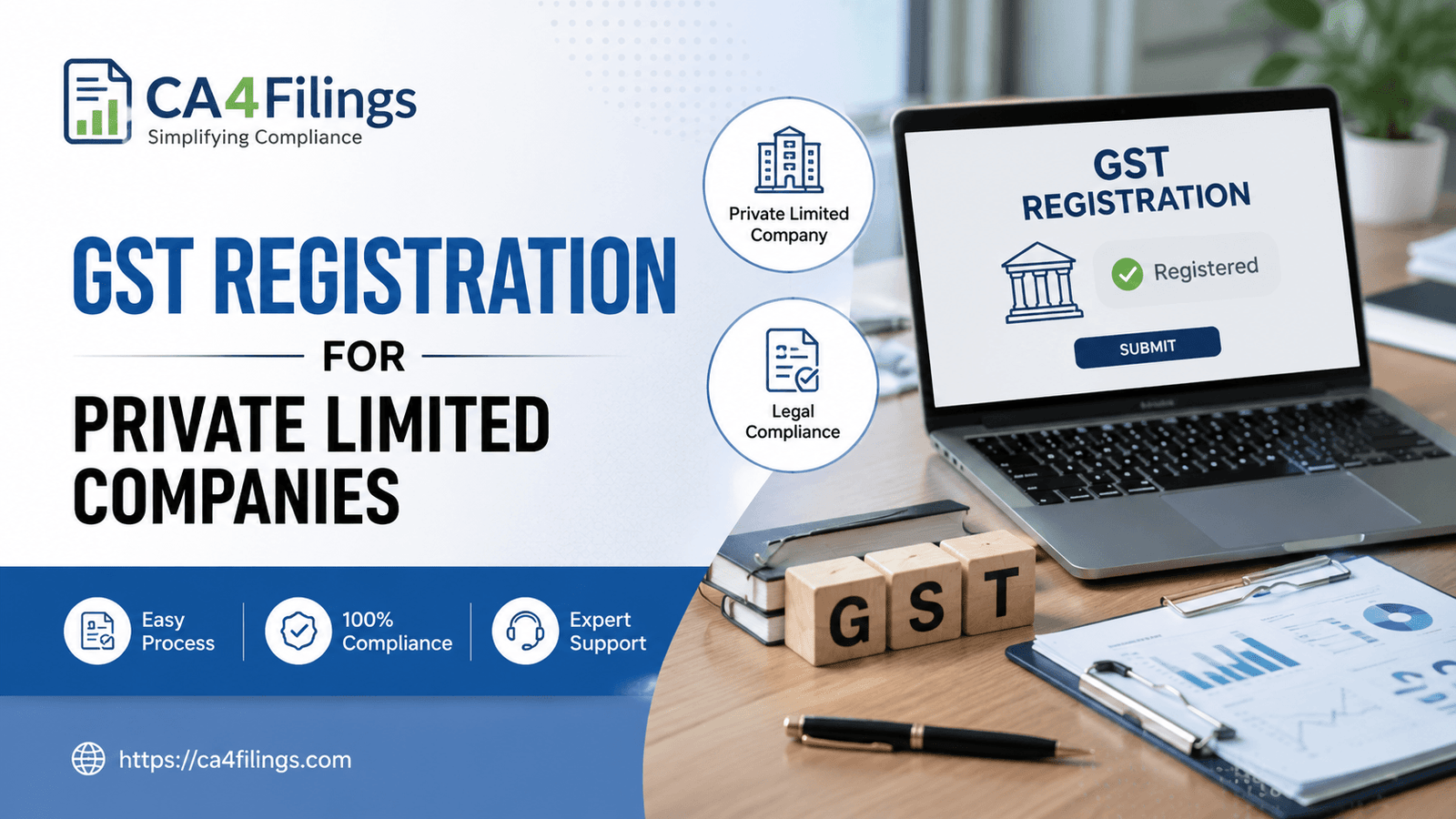
Starting a Private Limited Company is an exciting step for any entrepreneur. Whether you are launching a startup, entering e-commerce, providing services, or expanding your business operations, legal and tax compliance becomes a critical part of your journey. One of the most important compliance requirements today is GST Registration for Private Limited Companies.
Many business owners assume GST registration is only needed when turnover crosses a certain threshold. However, for Private Limited Companies, the situation is often broader and depends on factors like business activities, interstate transactions, and online selling. Understanding the process early can help avoid penalties and unnecessary complications.
At CA4Filings, we regularly guide businesses through compliance procedures, and businesses often approach us for professional support related to GST Registration to ensure smooth and hassle-free registration without delays.
What is GST Registration for Private Limited Companies?
GST Registration for Private Limited Companies refers to obtaining a unique Goods and Services Tax Identification Number (GSTIN) from the government to legally collect and remit GST.
GST is a unified tax system introduced in India to replace multiple indirect taxes. Once a company receives GST registration, it can:
- Collect GST from customers
- Claim Input Tax Credit (ITC)
- Issue GST-compliant invoices
- Conduct interstate business legally
- Sell through e-commerce platforms
A GSTIN acts as an official tax identity for your company under the GST framework.
Who Needs GST Registration for Private Limited Companies?
Not every company is required to register immediately, but several situations make registration compulsory.
Mandatory Cases for GST Registration
A Private Limited Company must obtain GST registration if it falls under the following categories:
- Annual turnover exceeds prescribed limits
- Selling goods or services across states
- Selling products through online marketplaces
- Importing or exporting goods and services
- Acting as an e-commerce operator
- Paying tax under reverse charge mechanism
- Voluntary registration for business benefits
For example, imagine a Delhi-based software startup incorporated as a Private Limited Company. Even if its revenue is initially low, if it starts providing services to clients across multiple states, GST registration may become necessary.
Benefits of GST Registration for Private Limited Companies
Many entrepreneurs view GST as only a compliance requirement, but registration offers several practical advantages.
Better Business Credibility
Businesses with GST registration often appear more trustworthy to clients, vendors, and investors.
Large organizations generally prefer dealing with GST-registered entities because of invoice and tax credit benefits.
Claim Input Tax Credit
One of the biggest advantages is claiming credit on taxes paid on business expenses.
This may include:
- Office rent
- Professional services
- Machinery purchases
- Software subscriptions
- Raw materials
Without GST registration, this tax benefit cannot be claimed.
Interstate Expansion Opportunities
A registered company can operate smoothly across different states without unnecessary restrictions.
For growing startups and online businesses, this becomes extremely valuable.
Access to E-commerce Platforms
Popular marketplaces usually require GST details from sellers.
If your Private Limited Company plans to sell products online, GST registration often becomes essential.
Documents Required for GST Registration for Private Limited Companies
Preparing documents in advance can save considerable time during registration.
The following documents are generally required:
Company Documents
- Certificate of Incorporation
- PAN card of the company
- Memorandum of Association (MOA)
- Articles of Association (AOA)
Director Documents
- PAN card of directors
- Aadhaar card
- Passport-size photographs
- Address proof
Business Address Proof
- Electricity bill
- Rent agreement
- Property tax receipt
- No Objection Certificate (if applicable)
Bank Documents
- Cancelled cheque
- Bank statement
Ensuring all documents are accurate and updated helps avoid delays during application processing.
Step-by-Step Process of GST Registration for Private Limited Companies
The registration process generally involves several stages.
Step 1: Prepare Documentation
Collect all necessary company and director documents before beginning the application.
Step 2: Submit GST Application
Details are submitted online through the GST portal, including:
- Business information
- Director details
- Principal place of business
- Bank details
Step 3: Verification Process
Authorities verify the information and may seek additional clarification if required.
Step 4: Receive GSTIN
After successful verification, the company receives a GST Identification Number and registration certificate.
Businesses can then begin issuing GST invoices legally.
Common Mistakes Businesses Should Avoid
Over the years, we have observed many companies making avoidable mistakes during GST registration.
Incorrect Documentation
Mismatched information between PAN, Aadhaar, and company records often creates delays.
Selecting Wrong Business Activity Codes
Wrong classification can lead to future compliance issues.
Delaying Registration
Waiting until business operations grow significantly may result in penalties.
Ignoring Compliance After Registration
Registration is only the beginning. Companies must continue with:
- GST return filing
- Invoice maintenance
- Record keeping
- Tax payments
Is Voluntary GST Registration a Good Option?
Even if your company does not legally require registration immediately, voluntary registration can still provide advantages.
Consider a newly incorporated marketing agency with annual revenue below threshold limits. If it wants to work with larger corporate clients, GST registration may improve business credibility and allow tax credit benefits.
Voluntary registration often supports long-term business growth.
FAQs on GST Registration for Private Limited Companies
Is GST registration compulsory immediately after company incorporation?
No. Incorporation alone does not automatically require GST registration. The requirement depends on turnover, business nature, and other specified conditions.
How long does GST registration take?
If documents are correct and no clarification is required, registration usually takes a few working days.
Can a Private Limited Company apply for voluntary GST registration?
Yes. Businesses can voluntarily register even if mandatory criteria are not met.
Can GST registration be cancelled later?
Yes. Registration may be cancelled if the company becomes ineligible or stops operations.
What happens if GST registration is delayed?
Late registration may result in penalties, compliance complications, and legal issues.
GST Registration for Private Limited Companies is not merely a legal formality; it plays an important role in business growth, credibility, and tax efficiency. Whether your company is a startup, service provider, manufacturer, or online seller, understanding GST requirements from the beginning helps avoid unnecessary hurdles later.
At CA4Filings, we understand that business owners prefer focusing on growth rather than getting stuck in compliance procedures. Our experienced professionals simplify GST Registration for Private Limited Companies and guide businesses through every stage with accuracy and transparency.
Ready to register your company under GST? Connect with CA4Filings today and let our experts handle the process while you focus on building your business.
Latest Updates
ca4filings.com Services

























-registration.png)