Exploring the Role of GST Council in Cancellation Policies
Exploring the Role of GST Council in Cancellation Policies: Learn how the GST Council shapes GST cancellation and revocation rules in India.
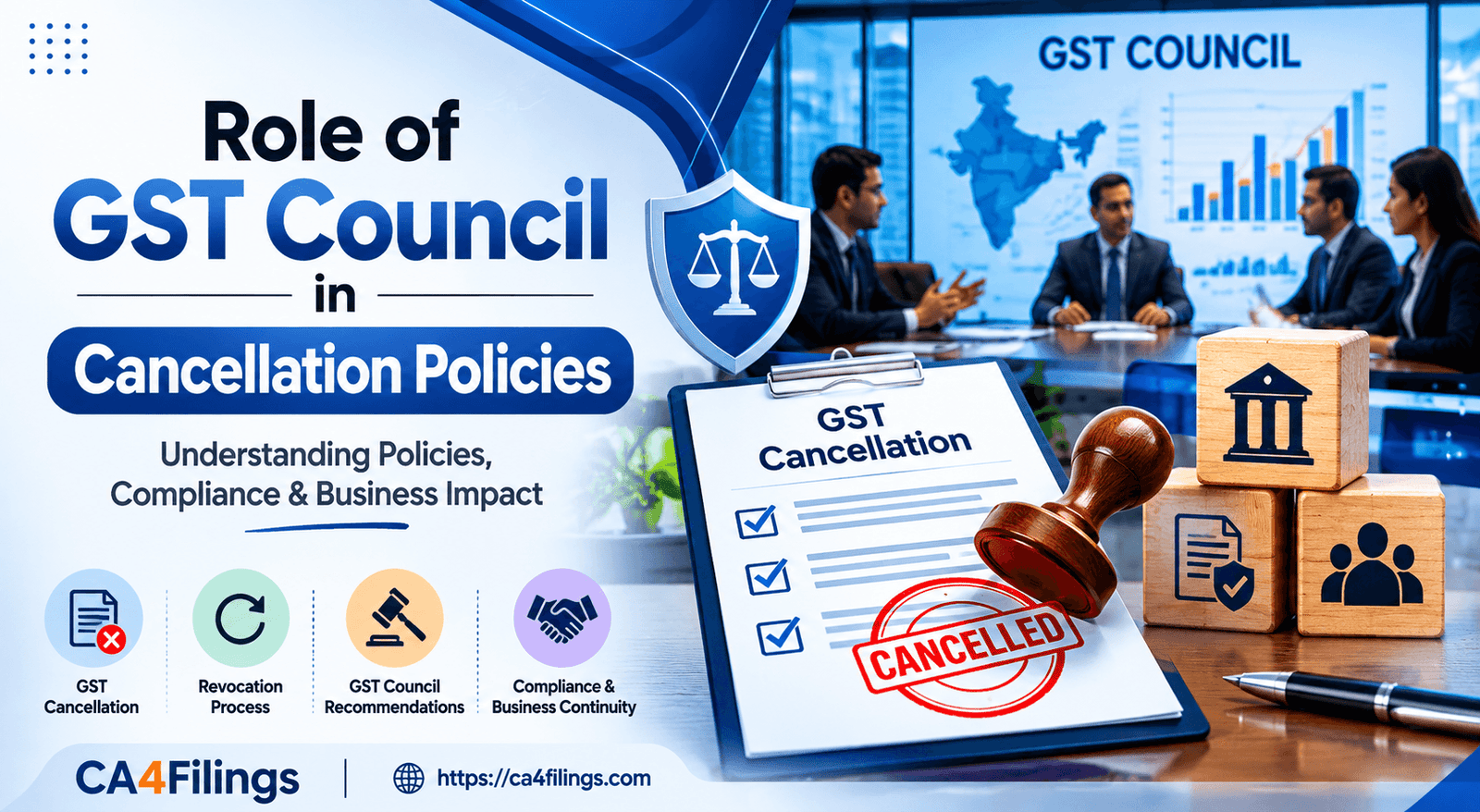
The Goods and Services Tax (GST) framework in India has transformed the country’s indirect taxation system by bringing multiple taxes under one umbrella. However, with evolving business practices and compliance requirements, the government also needed a strong mechanism to regulate GST registrations, especially in cases involving non-compliance or fraudulent activities. This is where Exploring the Role of GST Council in Cancellation Policies becomes highly relevant for taxpayers, businesses, and professionals alike.
The GST Council plays a crucial role in recommending policies related to GST registration cancellation and revocation. Whether a business voluntarily shuts down operations or faces cancellation due to non-filing of returns, the Council’s recommendations influence how these policies are framed and implemented across India.
For businesses facing registration-related issues, understanding the process of GST Cancellation & Revocation can help avoid penalties, legal complications, and operational disruptions.
Exploring the Role of GST Council in Cancellation Policies
When discussing Exploring the Role of GST Council in Cancellation Policies, it is important to first understand what the GST Council actually does.
The GST Council is a constitutional body established under Article 279A of the Indian Constitution. It consists of:
- The Union Finance Minister (Chairperson)
- State Finance Ministers
- Union Ministers of State for Finance
Its primary responsibility is to make recommendations on GST laws, procedures, rates, and compliance mechanisms.
One of the major areas where the GST Council has significantly contributed is GST registration cancellation policies. The Council continuously reviews compliance challenges faced by businesses and suggests practical reforms to simplify procedures while preventing tax evasion.
Why GST Registration Cancellation Matters
GST registration cancellation is not merely a technical process. It directly impacts:
- Business continuity
- Input tax credit eligibility
- Vendor relationships
- Legal compliance
- Financial credibility
A cancelled GST registration means the taxpayer can no longer legally collect GST or claim input tax credit.
Common Reasons for GST Cancellation
The GST registration may be cancelled due to several reasons, such as:
- Non-filing of GST returns for a continuous period
- Voluntary closure of business
- Change in business constitution
- Obtaining registration through fraud or misrepresentation
- Violation of GST provisions
In many such cases, the recommendations made by the GST Council shape the cancellation framework adopted by the government.
How the GST Council Influences Cancellation Policies
While Exploring the Role of GST Council in Cancellation Policies, one must understand that the Council itself does not directly cancel registrations. Instead, it recommends policy changes and procedural guidelines that are later implemented through GST notifications, circulars, and amendments.
Simplification of Cancellation Procedures
Over time, the GST Council has recommended simplifying cancellation procedures for small businesses and MSMEs.
Some notable improvements include:
- Online application process for cancellation
- Reduced documentation requirements
- Faster processing timelines
- Simplified revocation mechanisms
This has helped businesses reduce compliance burdens and avoid unnecessary litigation.
Focus on Non-Compliant Taxpayers
The GST Council has also played an active role in identifying systemic non-compliance.
To prevent revenue leakage, the Council has recommended stricter measures against:
- Fake invoicing
- Bogus firms
- Tax evasion networks
- Habitual non-filers
As a result, authorities now conduct data-driven scrutiny and suspend or cancel suspicious GST registrations more efficiently.
Relief Measures for Genuine Taxpayers
One of the most important aspects of Exploring the Role of GST Council in Cancellation Policies is understanding the balance between enforcement and taxpayer relief.
The Council has repeatedly recommended relief measures for genuine businesses, especially during difficult periods such as the COVID-19 pandemic.
Examples include:
- Extension of revocation deadlines
- Waiver of late fees
- Relaxation in return filing timelines
- Opportunity to restore cancelled registrations
These measures helped thousands of small businesses continue operations without severe financial stress.
Key GST Council Recommendations on Cancellation Policies
Revocation Window Extensions
Initially, taxpayers had limited time to apply for revocation of cancelled GST registration. However, based on practical difficulties faced by businesses, the GST Council recommended extending the timelines.
This provided relief to businesses that missed deadlines due to operational or financial challenges.
Technology-Driven Compliance Monitoring
The GST Council has encouraged the use of technology and analytics for identifying risky taxpayers.
Today, authorities use:
- E-way bill mismatches
- Return filing patterns
- Invoice data analysis
- AI-driven risk profiling
This helps ensure that cancellation actions are targeted rather than arbitrary.
Suspension Before Cancellation
Another significant reform influenced by the GST Council is the concept of suspension before cancellation.
Instead of immediate cancellation, authorities may first suspend the registration, allowing taxpayers to respond or rectify non-compliance.
This creates a more balanced and fair approach.
Practical Impact on Businesses
When Exploring the Role of GST Council in Cancellation Policies, businesses should also understand the practical implications of cancellation.
Impact on Input Tax Credit
Once registration is cancelled:
- Input tax credit becomes unavailable
- Vendors may stop doing business
- Customers may avoid transactions
This can severely affect cash flow and reputation.
Operational Disruptions
Businesses with cancelled GST registrations may face:
- Inability to issue tax invoices
- Restrictions on interstate transactions
- Legal notices and penalties
Therefore, proactive compliance is extremely important.
Increased Compliance Awareness
The GST Council’s evolving recommendations have also encouraged businesses to adopt better compliance practices such as:
- Timely return filing
- Proper bookkeeping
- Regular reconciliation
- Professional GST consultation
Steps Businesses Should Take to Avoid Cancellation
To stay compliant and avoid unnecessary GST registration cancellation, businesses should follow these best practices:
File GST Returns on Time
Consistent filing of GSTR-1 and GSTR-3B is critical.
Even nil returns should be filed within due dates.
Maintain Proper Documentation
Ensure that:
- Purchase invoices are accurate
- Sales records are updated
- E-way bills match invoices
- Books of accounts are properly maintained
Respond to GST Notices Promptly
Ignoring GST notices is one of the biggest mistakes businesses make.
Immediate professional assistance can help resolve issues before cancellation proceedings begin.
Conduct Periodic GST Health Checks
Regular GST reviews help identify:
- Return mismatches
- Input tax credit errors
- Vendor compliance risks
- Outstanding liabilities
Exploring the Role of GST Council in Cancellation Policies for MSMEs
MSMEs are among the most affected segments when GST registrations are cancelled.
Recognizing this, the GST Council has often introduced taxpayer-friendly recommendations specifically benefiting small businesses.
These include:
- Simplified return systems
- Amnesty schemes
- Reduced penalties
- Easier revocation processes
For small businesses operating with limited resources, these reforms provide much-needed flexibility.
FAQs
What is the role of the GST Council in GST cancellation policies?
The GST Council recommends policy changes, procedural reforms, and compliance measures related to GST registration cancellation and revocation.
Can a cancelled GST registration be restored?
Yes, businesses can apply for revocation of cancellation within the prescribed timeline if they meet compliance requirements.
What happens if GST returns are not filed regularly?
Continuous non-filing of GST returns can lead to suspension or cancellation of GST registration.
Does the GST Council directly cancel registrations?
No, the GST Council only makes recommendations. The actual cancellation is carried out by GST authorities.
How can businesses avoid GST cancellation?
Businesses should file returns on time, maintain accurate records, respond to notices promptly, and conduct regular GST compliance checks.
While Exploring the Role of GST Council in Cancellation Policies, it becomes clear that the GST Council serves as the backbone of India’s evolving GST compliance framework. Its recommendations help maintain a balance between strict enforcement against fraudulent taxpayers and genuine relief for compliant businesses.
From simplifying cancellation procedures to introducing taxpayer-friendly revocation measures, the Council has played a major role in shaping a more transparent and efficient GST ecosystem.
For businesses, staying GST-compliant is no longer optional—it is essential for long-term growth and credibility. Professional guidance can make the entire process smoother and help businesses avoid costly compliance mistakes.
At CA4Filings, our experienced professionals assist businesses with GST cancellation, revocation, return filing, and complete GST compliance support. If your business is facing GST-related challenges, connect with CA4Filings today and ensure hassle-free compliance with expert assistance.
Latest Updates
ca4filings.com Services
























-registration.png)