Understanding the Differences Between DIR-3 and Other KYC Forms
Understanding the Differences Between DIR-3 and Other KYC Forms explained simply for directors, businesses, and professionals in India.
For directors and professionals associated with companies in India, compliance with the Ministry of Corporate Affairs (MCA) is not optional—it is a critical responsibility. One of the most important annual compliance requirements is director KYC filing. However, many business owners and directors often get confused while Understanding the Differences Between DIR-3 and Other KYC Forms.
At CA4Filings, we regularly assist directors who are unsure about which KYC form applies to them, the filing process, penalties for non-compliance, and how DIR-3 differs from other verification forms under MCA regulations. If you are planning to complete your DIR-3 KYC filing, understanding these differences can save you from unnecessary penalties and compliance issues.
In this article, we will simplify the entire concept and help you clearly understand the purpose, applicability, and importance of various KYC forms used in India.
Understanding the Differences Between DIR-3 and Other KYC Forms
When people hear the term “KYC,” they usually think of bank verification or Aadhaar linking. However, in corporate compliance, KYC forms are used for verifying the identity and contact details of directors, designated partners, and individuals connected with legal entities.
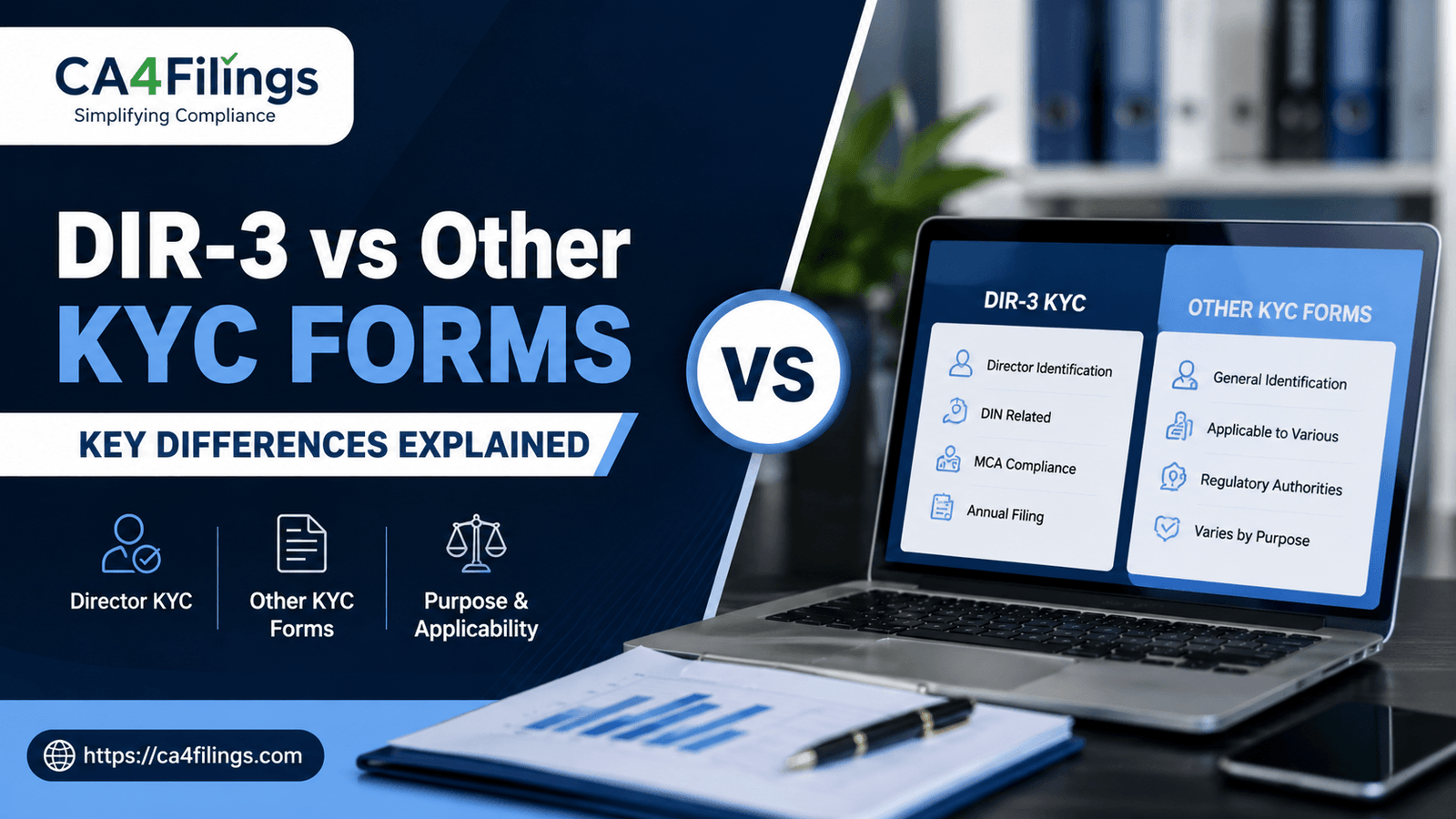
DIR-3 KYC is specifically designed for directors holding a Director Identification Number (DIN). Other KYC forms may apply to LLP partners, financial institutions, GST registrations, or other regulatory bodies.
Understanding the Differences Between DIR-3 and Other KYC Forms becomes essential because filing the wrong form or missing the deadline can lead to deactivation of DIN and financial penalties.
What is DIR-3 KYC?
DIR-3 KYC is an MCA compliance form filed annually by directors who possess a DIN. The purpose of this form is to verify and update the director’s:
- Mobile number
- Email address
- PAN details
- Aadhaar details
- Residential address
The MCA introduced this form to maintain accurate records of directors and reduce fraudulent corporate activities.
Who Needs to File DIR-3 KYC?
Every individual who has been allotted a DIN on or before the financial year-end must file DIR-3 KYC.
This applies even if:
- The director is inactive
- The company is non-operational
- The DIN was never used
Failure to file the form on time can lead to:
- DIN deactivation
- Late filing penalties
- Difficulty in future MCA filings
Types of DIR-3 KYC Forms
DIR-3 KYC Form
This is the standard web-based or e-form filing applicable for directors filing KYC for the first time or updating details.
DIR-3 KYC Web
This simplified version is available for directors whose details remain unchanged from the previous filing year.
Understanding the Differences Between DIR-3 and Other KYC Forms also includes understanding the distinction between these two variants.
Difference Between DIR-3 KYC and Other KYC Forms
Purpose of Filing
DIR-3 KYC is specifically related to MCA and DIN verification.
Other KYC forms may be linked to:
- Banks
- GST authorities
- SEBI compliance
- LLP registrations
- Financial institutions
For example:
- Bank KYC verifies customer identity for financial transactions.
- GST KYC verifies business authenticity for tax purposes.
- LLP Form 8 or Form 11 relates to LLP compliance, not director DIN verification.
Regulatory Authority
DIR-3 KYC is regulated by:
- Ministry of Corporate Affairs (MCA)
Other KYC forms may be regulated by:
- RBI
- SEBI
- GST Department
- UIDAI
This is one of the key aspects while Understanding the Differences Between DIR-3 and Other KYC Forms.
Applicability
DIR-3 KYC applies only to:
- Directors with DIN
Other KYC forms apply to:
- Bank account holders
- GST taxpayers
- Investors
- LLP partners
- Financial account users
Filing Frequency
DIR-3 KYC must be filed annually.
Other KYC forms may be:
- One-time
- Periodic
- Trigger-based upon data change
Consequences of Non-Compliance
If DIR-3 KYC is not filed:
- DIN becomes deactivated
- MCA filing restrictions arise
- Late fees apply
If bank or GST KYC is not completed:
- Bank accounts may freeze
- GST registration may get suspended
- Financial transactions may stop
Why DIR-3 KYC is Important for Directors
Many directors assume that if their company is inactive, compliance is unnecessary. This is one of the biggest misconceptions.
At CA4Filings, we often see directors facing penalties simply because they ignored annual KYC requirements.
Here’s why DIR-3 KYC matters:
Maintains Active DIN Status
Without an active DIN, directors cannot:
- Sign MCA forms
- Incorporate companies
- Continue directorship activities
Prevents Heavy Penalties
Delayed filing attracts additional government fees and compliance complications.
Enhances Corporate Transparency
The MCA uses KYC verification to reduce:
- Fake directorships
- Shell companies
- Fraudulent activities
Understanding the Differences Between DIR-3 and Other KYC Forms helps directors remain compliant and avoid regulatory scrutiny.
Documents Required for DIR-3 KYC
To complete the filing successfully, directors generally require:
- PAN Card
- Aadhaar Card
- Passport (for foreign nationals)
- Mobile number
- Email ID
- Address proof
- Digital Signature Certificate (DSC)
It is important that the mobile number and email ID remain active because OTP verification is mandatory.
Common Mistakes Directors Make
Ignoring MCA Notifications
Many directors overlook MCA compliance reminders, assuming the company auditor will automatically handle everything.
Using Incorrect Contact Information
OTP verification failure is common due to outdated mobile numbers or email IDs.
Filing at the Last Minute
The MCA portal often experiences heavy traffic near due dates. Delayed preparation may result in missed deadlines.
Assuming One KYC Covers Everything
A major reason behind confusion is lack of awareness regarding Understanding the Differences Between DIR-3 and Other KYC Forms.
Bank KYC, GST KYC, and MCA KYC are all separate compliances.
Step-by-Step Process to File DIR-3 KYC
Step 1: Gather Documents
Ensure all identification and address documents are updated and self-attested.
Step 2: Verify DIN Details
Check whether the DIN status is active on the MCA portal.
Step 3: Prepare DSC
A valid Digital Signature Certificate is mandatory.
Step 4: Complete OTP Verification
Email and mobile verification are completed through OTP authentication.
Step 5: Submit Form on MCA Portal
The form is digitally signed and uploaded online.
Step 6: Confirmation from MCA
After successful processing, acknowledgment is generated.
At CA4Filings, we recommend completing the process well before the due date to avoid technical issues.
Practical Example for Better Understanding
Suppose Mr. Sharma is:
- A company director
- A GST-registered trader
- A bank account holder
He may need:
- DIR-3 KYC for DIN compliance
- GST KYC for tax registration
- Bank KYC for banking operations
Each form serves a completely different regulatory purpose.
This practical scenario clearly explains Understanding the Differences Between DIR-3 and Other KYC Forms.
FAQs
Is DIR-3 KYC mandatory every year?
Yes. Every DIN holder must complete DIR-3 KYC annually unless exempted by MCA regulations.
What happens if DIR-3 KYC is not filed?
The DIN may become deactivated, and penalties may apply for reactivation.
Can DIR-3 KYC be filed without DSC?
No. A valid DSC is generally required for filing.
Is DIR-3 KYC applicable for inactive companies?
Yes. The requirement applies to the director’s DIN status, not the company’s operational status.
Are bank KYC and DIR-3 KYC the same?
No. Understanding the Differences Between DIR-3 and Other KYC Forms is important because both compliances are governed by different authorities and serve different purposes.
Understanding the Differences Between DIR-3 and Other KYC Forms is essential for every director, entrepreneur, and business owner in India. While many KYC processes may appear similar, each serves a unique legal and regulatory purpose.
DIR-3 KYC specifically focuses on verifying director identity under MCA compliance regulations. Missing this filing can lead to DIN deactivation, penalties, and future compliance difficulties.
At CA4Filings, we help directors and companies complete their filings accurately, on time, and without unnecessary stress. Whether you are filing for the first time or need assistance with delayed compliance, our expert team ensures a smooth and hassle-free process.
If you want professional support for DIR-3 filings and annual MCA compliance, connect with CA4Filings today and stay fully compliant with confidence.
Latest Updates
ca4filings.com Services




























-registration.png)