Common Misconceptions About DIR-3 KYC Explained
Common Misconceptions About DIR-3 KYC Explained – Learn myths, compliance rules, due dates, penalties, and expert guidance from CA4Filings.
Many directors in India still face confusion when it comes to DIR-3 KYC compliance. Over the years, we at CA4Filings have noticed that several business owners, startup founders, and company directors either misunderstand the process or rely on incorrect information shared informally. This often leads to delayed filings, DIN deactivation, and unnecessary penalties.
In this article on “Common Misconceptions About DIR-3 KYC Explained,” we will clear up the most common myths surrounding the DIR-3 KYC filing process and help you understand the actual compliance requirements under the Companies Act, 2013.
If you are a director or planning to become one, understanding the filing requirements of DIR-3 KYC is extremely important to avoid future compliance issues.
What is DIR-3 KYC?
DIR-3 KYC is a mandatory KYC filing introduced by the Ministry of Corporate Affairs (MCA) for individuals holding a Director Identification Number (DIN). Every director with an approved DIN must complete this annual compliance to keep their DIN active.
The objective behind DIR-3 KYC is simple:
- Verify director details
- Maintain updated records with MCA
- Prevent misuse of inactive DINs
- Improve corporate transparency
The filing generally includes:
- Director’s PAN
- Aadhaar details
- Mobile number
- Email ID
- Residential address
- OTP verification
Despite the process being straightforward, several misconceptions continue to create confusion. Let us now discuss the most common ones.
Common Misconceptions About DIR-3 KYC Explained for Directors
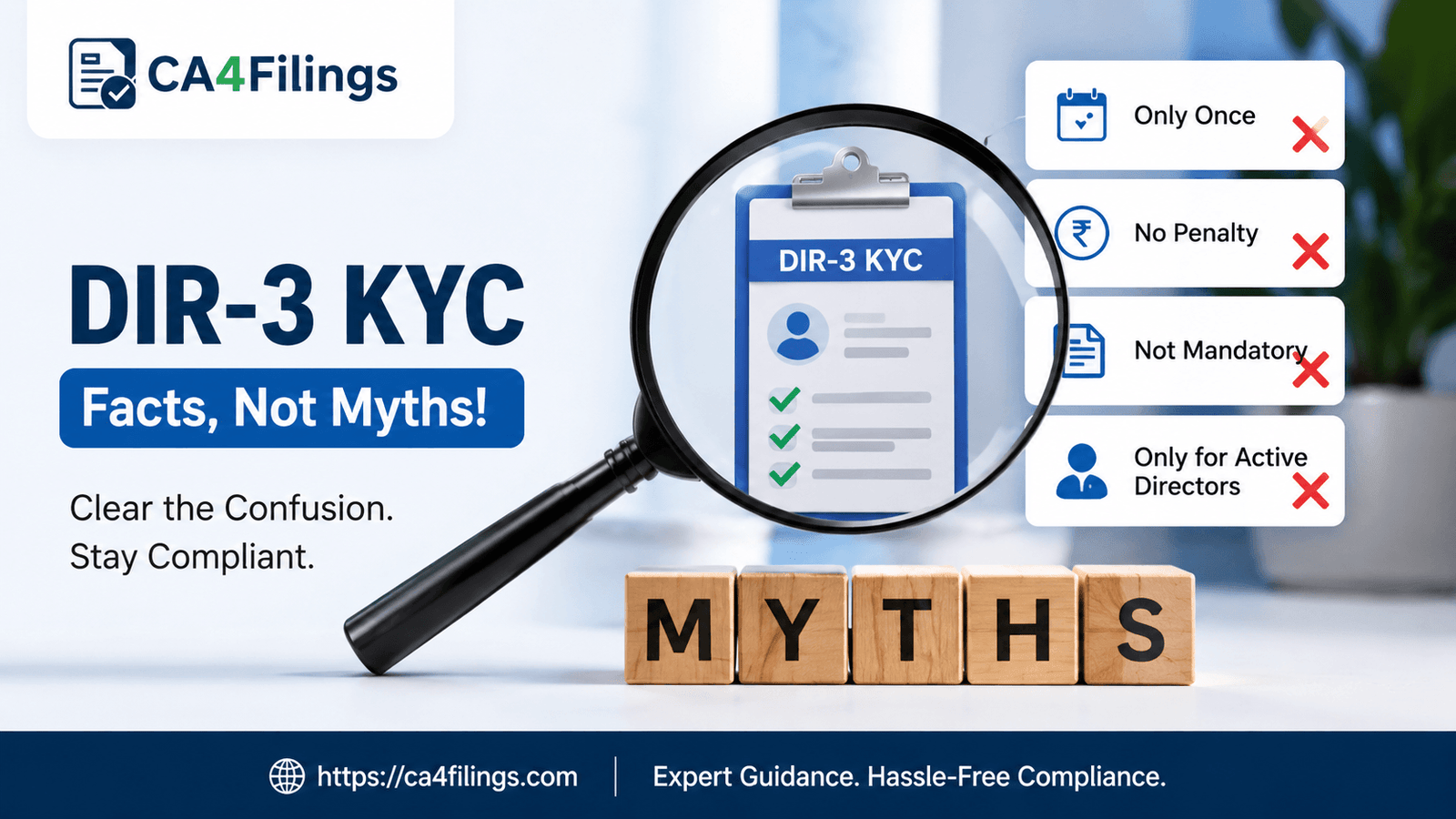
DIR-3 KYC is Required Only Once
This is one of the most common myths we hear from directors.
Many individuals believe that once they complete their KYC filing, there is no need to file again. However, this is incorrect.
DIR-3 KYC is generally an annual compliance requirement for directors whose DIN status is approved. Even if there are no changes in details, directors may still need to complete yearly compliance through the applicable MCA process.
For example, a director in a private limited company who filed KYC last year may still be required to complete the compliance this year to keep the DIN active.
Missing the annual filing can result in DIN deactivation.
Common Misconceptions About DIR-3 KYC Explained Regarding Penalties
There is No Serious Consequence for Missing DIR-3 KYC
Another dangerous misconception is that delayed filing does not create major problems.
In reality, non-compliance can create several complications, such as:
- DIN getting marked as “Deactivated”
- Inability to sign MCA forms
- Delays in company filings
- Additional government fees
- Compliance notices
In many cases, directors only realise the issue when they are unable to file ROC forms for their company.
A startup founder recently approached CA4Filings after failing to file annual company returns because one director’s DIN had become inactive due to non-filing of DIR-3 KYC. The delay eventually impacted other statutory compliances as well.
This is why timely compliance is extremely important.
Common Misconceptions About DIR-3 KYC Explained for Inactive Directors
Directors of Non-Operational Companies Do Not Need DIR-3 KYC
This is partially incorrect.
Many directors assume that if their company is inactive, struck off, or not conducting business, they are exempt from KYC filing. However, the requirement is linked to the DIN status, not the business activity of the company.
If an individual holds an approved DIN, compliance obligations may still apply.
For example:
- Directors of dormant companies
- Additional directors
- Nominee directors
- Directors in inactive private limited companies
may still need to complete DIR-3 KYC requirements.
Ignoring the filing simply because business operations have stopped can create future complications when starting a new venture or joining another company.
Common Misconceptions About DIR-3 KYC Explained About Professional Certification
Anyone Can File DIR-3 KYC Without Verification
Technically, the form filing process may appear simple, but many directors underestimate the importance of professional verification.
DIR-3 KYC filings usually require certification from a practising professional such as:
- Chartered Accountant
- Company Secretary
- Cost Accountant
Incorrect filing of details like PAN mismatch, wrong mobile number, or email discrepancies may result in rejection or complications.
At CA4Filings, we often notice errors such as:
- Name mismatch with PAN database
- Incorrect Aadhaar linkage
- Invalid DSC registration
- Expired Digital Signature Certificate
Professional review helps avoid these common mistakes.
Common Misconceptions About DIR-3 KYC Explained for Foreign Directors
Foreign Directors Do Not Need DIR-3 KYC
This is another area where confusion is very common.
Foreign nationals holding DINs are also generally required to comply with DIR-3 KYC requirements.
However, the documentation process may differ slightly. Foreign directors may need:
- Passport details
- Overseas address proof
- Apostilled or notarised documents
- Valid international mobile/email details
Many multinational subsidiaries in India face delays because foreign directors are unaware of Indian MCA compliance requirements.
Proper planning and documentation can help avoid last-minute complications.
Common Misconceptions About DIR-3 KYC Explained About Mobile Numbers
One Mobile Number Can Be Used for Multiple Directors
This misunderstanding creates major filing issues.
Generally, every director should use their own unique mobile number and email address for verification purposes. MCA uses OTP-based authentication during the filing process.
Using shared contact details may result in:
- OTP failures
- Verification issues
- Filing rejection
- Compliance delays
For example, in family-owned businesses, directors sometimes use a common email ID for convenience. This can create unnecessary confusion during KYC filing.
It is always advisable for each director to maintain separate and updated contact details.
Important Documents Required for DIR-3 KYC
To avoid last-minute stress, directors should keep the following documents ready:
Basic Documents
- PAN Card
- Aadhaar Card
- Passport (for foreign nationals)
- Address proof
- Mobile number
- Email ID
Additional Requirements
- Digital Signature Certificate (DSC)
- Professional certification
- OTP verification access
Keeping documents updated and matching government records is extremely important for smooth approval.
Step-by-Step Process for DIR-3 KYC Filing
Here is a simplified overview of the filing process:
Step 1: Collect Required Documents
Ensure PAN, Aadhaar, address proof, and DSC are valid and updated.
Step 2: Verify Contact Details
Keep access to the registered mobile number and email ID for OTP verification.
Step 3: Prepare the DIR-3 KYC Form
Enter all details carefully without spelling errors or mismatches.
Step 4: Professional Certification
A practising professional verifies and certifies the form.
Step 5: Submit on MCA Portal
The form is uploaded electronically through the MCA system.
Step 6: Acknowledgement and Approval
Once successfully processed, the DIN remains active.
Why Professional Assistance Matters
Many directors think DIR-3 KYC is just a small annual formality. However, even minor mistakes can lead to technical rejection or DIN deactivation.
Professional assistance helps in:
- Accurate filing
- DSC verification
- Avoiding penalties
- Timely compliance
- Resolving DIN issues
At CA4Filings, we regularly assist directors, startups, LLP partners, and companies in handling smooth DIR-3 KYC compliance without unnecessary delays.
FAQs on Common Misconceptions About DIR-3 KYC Explained
Is DIR-3 KYC mandatory for all directors?
Generally, directors holding an approved DIN are required to comply with DIR-3 KYC requirements.
What happens if DIR-3 KYC is not filed?
Non-filing may result in DIN deactivation along with additional compliance complications and penalties.
Can I use the same email ID for multiple directors?
It is advisable for every director to use separate email IDs and mobile numbers for verification purposes.
Is professional certification compulsory?
Yes, DIR-3 KYC filings generally require certification from a practising professional.
Can foreign directors complete DIR-3 KYC?
Yes, foreign directors with DINs are also required to comply with applicable KYC requirements.
Understanding “Common Misconceptions About DIR-3 KYC Explained” is extremely important for every company director in India. Many compliance defaults happen not because directors intentionally ignore the rules, but because they rely on incomplete or incorrect information.
DIR-3 KYC is not just a routine filing—it is an important compliance requirement that helps maintain the active status of your DIN and ensures smooth corporate functioning.
At CA4Filings, we help directors complete their filings accurately, avoid penalties, and stay fully compliant with MCA regulations. If you need professional support for DIR-3 KYC filing, our experienced team is ready to guide you with reliable and hassle-free compliance services.
Latest Updates
ca4filings.com Services


























-registration.png)