Renewing Your DIN: What You Need to Know
Master the new 3-year rules for Renewing Your DIN: What You Need to Know. Avoid a ₹5,000 penalty and DIN deactivation with expert insights from CA4Filings.
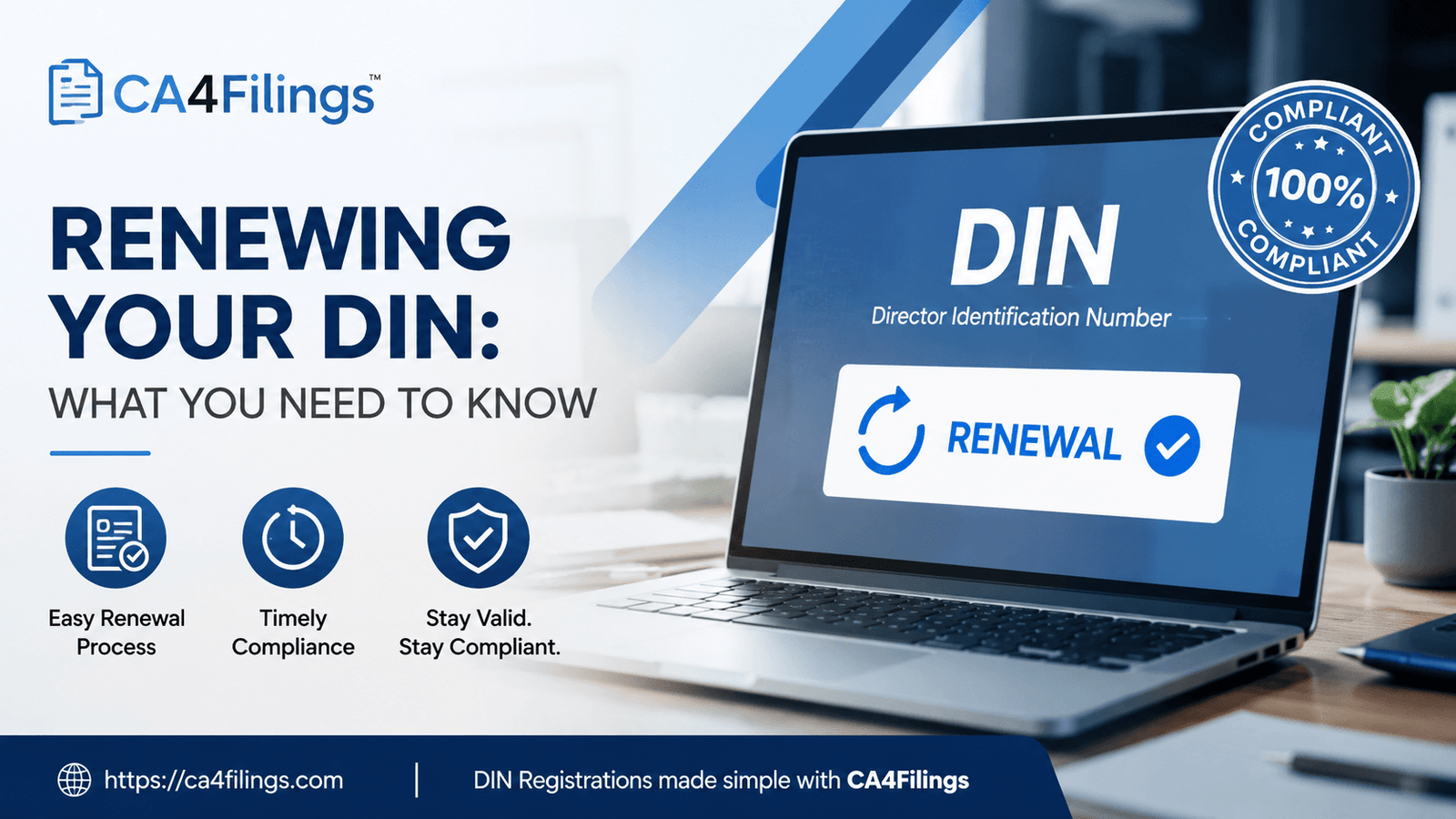
Running a business in India demands keeping a constant eye on statutory compliances. As a director or a designated partner in an LLP, you already know that your Director Identification Number (DIN) is your unique identity in the corporate world. However, many business owners mistakenly believe that once a DIN is allotted, it remains active forever without any maintenance. The truth is quite different. The Ministry of Corporate Affairs (MCA) has drastically overhauled the rules surrounding director verification. Staying updated on the framework for Renewing Your DIN: What You Need to Know is absolute table stakes if you want to protect your company from sudden regulatory roadblocks.
At CA4Filings, we frequently meet founders who realize their DIN has been deactivated only when they try to sign an urgent Board Resolution or file annual financial statements. To ensure your company's operations run without any unexpected legal hitches, the first step is obtaining a valid unique identity through DIN Registration, which establishes your legal footing under the Companies Act. Once that foundation is set, you must navigate the ongoing maintenance and compliance cycles required to keep that identity active.
Let us break down everything you need to know about keeping your DIN active under the latest MCA framework, written in plain, jargon-free language.
What Exactly Does "Renewing Your DIN" Mean?
Legally speaking, a DIN does not have an "expiry date" like a passport or a driving license. Once allotted, it belongs to you for life. However, "renewing" your DIN refers to the mandatory periodic verification process known as DIR-3 KYC.
The MCA introduced this compliance to clean up its database, weed out ghost directors, and ensure that every individual holding a DIN can be reached via a verified mobile number, email address, and physical location. If you do not perform this periodic verification within the deadline, the MCA system flags your DIN as "Deactivated due to non-filing of KYC."
The Massive 2026 Regulatory Shift: No More Annual Filing!
If you have been managing a company for a few years, you probably remember completing your DIR-3 KYC every single year by September 30th.
Major Compliance Relief: The MCA officially amended the Companies (Appointment and Qualification of Directors) Rules. The old, painful annual filing cycle has been replaced with a streamlined three-year compliance cycle.
Here are the operational rules under this updated framework for Renewing Your DIN: What You Need to Know:
The 3-Year Rule: You only need to file your routine routine DIR-3 KYC Web intimation once every third consecutive financial year.
The New Deadline: The deadline has shifted from September 30th to June 30th of that applicable third year.
The 30-Day Trigger for Changes: While routine filings are now triennial, if you change your personal mobile number, email ID, or residential address, you cannot wait for the three-year window. You must report these changes by filing the form within 30 days of the change, along with the prescribed fee.
How to Check Your Current DIN Status
Before jumping into filings, you need to know where your DIN stands. You can log into the MCA portal and use the "Check DIN Status" service. Your DIN will generally reflect one of two primary states:
Approved / Active
This means your compliances are completely up to date. You are fully authorized to sign corporate documents, file forms with the Registrar of Companies (ROC), and act on behalf of your company.
Deactivated due to Non-Filing of DIR-3 KYC
This is the danger zone. It means you missed your compliance window. The system locks your Digital Signature Certificate (DSC) from being used on the portal, which completely paralyzes your ability to file company returns like Form AOC-4 or MGT-7.
Step-by-Step Process to Keep Your DIN Active
When it is your turn in the cycle to complete the process for Renewing Your DIN: What You Need to Know, the procedure moves through a clear set of steps on the MCA V3 portal:
Verify Your Credentials: Gather your PAN card, Aadhaar card, or Passport (which is mandatory if you are a foreign national holding an Indian DIN). Ensure the spelling of your name and your father's name matches perfectly across all documents.
Update or Renew Your DSC: Your Digital Signature Certificate must be active and registered on the MCA portal against your DIN. If it has expired, you need to obtain a new Class 3 DSC first.
Access the DIR-3 KYC Form: Log into the portal. If your details have remained exactly the same since your last filing, you will use the simplified web-based verification. If you are updating credentials or reactivating a lapsed DIN, you must use the comprehensive electronic form.
OTP Authentication: The system will send two distinct One-Time Passwords (OTPs)—one to your personal mobile number and another to your personal email address. Both must be successfully validated within their expiry windows.
Professional Certification: If you are using the full e-form version, the document must be digitally signed and certified by a practicing professional—such as a Chartered Accountant (CA), Company Secretary (CS), or Cost Accountant (CMA).
The Consequences of Missing the Deadline
Procrastinating on corporate compliance can quickly turn into an expensive headache. If you do not prioritize Renewing Your DIN: What You Need to Know, you will immediately face two distinct penalties:
1. The ₹5,000 Late Fee
Filing your KYC on time carries zero government fees. However, the moment you miss the June 30th deadline of your applicable due year, the system automatically levies a flat, non-negotiable penalty of ₹5,000 per director to reactivate the DIN.
2. Operational Paralysis
While a ₹5,000 fine hurts, the secondary operational damage is often much worse. A deactivated DIN prevents the company from completing its routine monthly and annual filings. This delays your ROC compliances, triggering separate per-day penalties for the company itself, and can badly damage your corporate credit rating when dealing with banks or investors.
Frequently Asked Questions (FAQs)
Q1: I am a director of a dormant company with no business transactions. Do I still need to file KYC?
Yes. As long as you hold an "Approved" DIN, you must complete the KYC verification according to the regular cycle. The operational status or turnover of your company has absolutely no bearing on your personal DIN compliance requirements.
Q2: What happens if my mobile number or email changes mid-cycle?
You must file the DIR-3 KYC Web form to update your contact details within 30 days of the change. Please note that updating your details mid-cycle does not reset your overall three-year compliance clock; your next routine filing remains tied to its original timeline.
Q3: Can I use my company accountant's email ID for the OTP verification?
We strongly advise against this. The MCA explicitly requires unique, personal contact details for each individual director. Using a shared company email or an accountant's phone number can lead to system errors, security risks, or a rejection of your form.
Q4: My DIN is deactivated right now. How do I make it active again?
To reactivate your DIN, you must complete the full DIR-3 KYC process, get it certified by a practicing professional (like our team at CA4Filings), and pay the standard ₹5,000 late filing penalty on the MCA portal.
Let CA4Filings Handle Your Compliances
Navigating the transition to the new three-year compliance cycle while keeping track of your specific due dates requires consistent, professional monitoring. When dealing with Renewing Your DIN: What You Need to Know, a single minor data mismatch or a missed timeline can disrupt your entire business operations.
At CA4Filings, we take the regulatory weight completely off your shoulders. Our corporate compliance team tracks your filing cycles, verifies your documents against your PAN and Aadhaar records, manages your OTP authentications, and provides the mandatory professional certifications seamlessly.
Latest Updates
ca4filings.com Services























-registration.png)