Why Retail Brands Are Moving from Partnerships to register llp Frameworks
Are you scaling your retail business? Discover why modern brands are choosing to register LLP to ensure liability protection and growth.
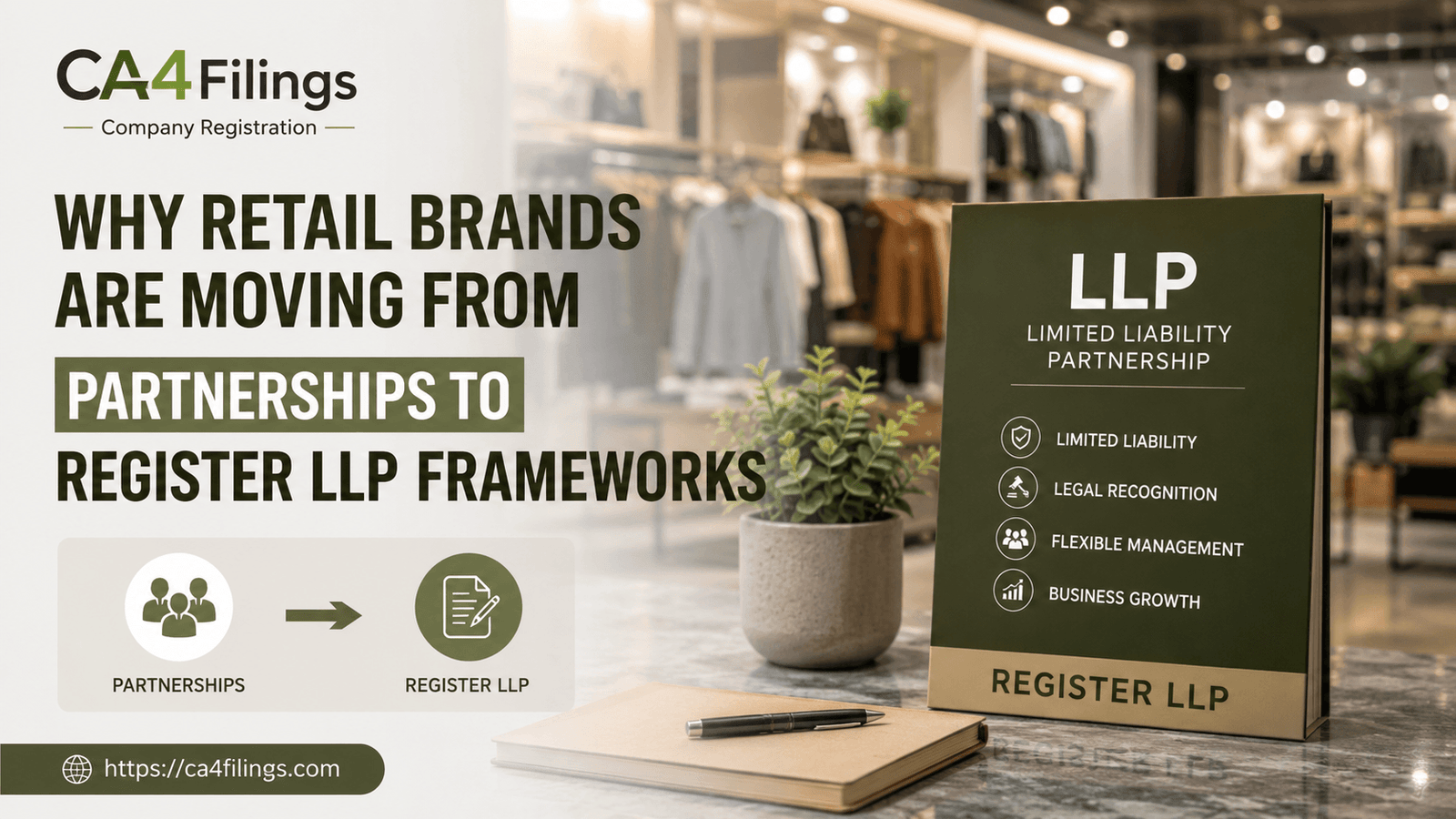
In the fast-paced world of Indian retail, business owners often start with humble beginnings, frequently opting for traditional partnership firms due to their simplicity. However, as your brand grows across cities and your operations become more complex, the limitations of an old-school partnership can become a bottleneck. At CA4Filings, we often see successful retailers reaching a point where they need a more robust legal structure. Whether you are looking to streamline your operations or preparing for professional Company Registration to secure your brand's future, understanding the shift toward the Limited Liability Partnership (LLP) model is essential for long-term survival.
Today, we are seeing a massive trend where retail brands are choosing to register LLP frameworks to replace their existing partnership deeds. Let’s dive into why this transition is not just a legal formality but a strategic business move.
Why Retail Brands are Choosing to Register LLP
The retail industry is inherently risky—you deal with thousands of customers, inventory fluctuations, and lease agreements. In a general partnership, you are personally liable for the business’s debts. If a shop faces a sudden liability or legal issue, your personal home or savings could be at risk.
When you register LLP, you create a "corporate shield." The business becomes a separate legal entity, meaning your personal assets are protected. For retail owners managing multiple outlets, this liability mitigation is the primary driver for making the switch.
The Operational Advantages of an LLP for Retail
As your business grows, so does the complexity of your management. Here is how an LLP helps modern retail brands:
1. Simplified Multi Outlet Management
Operating across different malls or cities requires a clear chain of command and centralized decision-making. Unlike a partnership, which can feel informal and chaotic during disputes, an LLP operates under a formal agreement. This structure allows for better multi outlet management, where roles, profit-sharing, and decision-making powers are clearly defined by law.
2. Boosting Investor Transparency
If you are planning to raise funds or bring in silent partners to open new stores, your current partnership deed won't cut it. Investors today demand professional documentation. When you register LLP, you provide a higher level of investor transparency. It shows that your business follows statutory norms, maintains audited financial statements, and is managed professionally—making it easier to attract expansion capital.
3. Ease of Access to Capital
Growth in retail is expensive. Whether it’s interior fit-outs or stocking inventory for a new season, you often need expansion capital loans. Banks and financial institutions prefer lending to an LLP because it has a distinct legal existence and a structured, predictable management style compared to a traditional, fluid partnership firm.
Key Differences: Partnership vs. LLP
To help you decide, here is a quick look at how these structures compare in the Indian market:
| Feature | Partnership Firm | Limited Liability Partnership (LLP) |
|---|---|---|
| Liability | Unlimited (Personal risk) | Limited (Asset protection) |
| Legal Status | Same as partners | Separate legal entity |
| Management | Informal | Defined by agreement |
| Credibility | Lower | Higher (Standardized) |
| Perpetual Succession | No (Dissolves if partners leave) | Yes (Business continues) |
Step-by-Step: The Transition Process
Moving from a partnership to an LLP is a structured process that ensures your business continuity remains uninterrupted. Here is how we at CA4Filings handle this transition:
Obtain Digital Signatures (DSC): Every partner needs a DSC to sign the electronic documents.
Name Approval: You can often retain your existing brand name while you register LLP.
Conversion Filing: We file the necessary forms (specifically Form 17) to convert your existing firm into an LLP under the LLP Act, 2008.
Transfer of Assets: All existing assets, licenses, and contracts of the partnership are legally transferred to the new entity.
LLP Agreement: We help you draft a comprehensive agreement that protects your long-term interests.
Frequently Asked Questions (FAQs)
Q: Does registering as an LLP make taxes more complicated?
A: Not at all. In fact, many retailers find it more efficient. LLPs avoid the "double taxation" that companies often face, and you can still deduct partner remuneration as a business expense.
Q: Can I keep my existing store name after I register LLP?
A: Yes, in most cases, you can continue to operate under your existing brand name. We ensure that the brand goodwill you have built over the years stays with your business.
Q: Is it mandatory to audit my retail business if I choose to register LLP?
A: Audit requirements for LLPs only kick in if your annual turnover exceeds ₹40 lakhs or your capital contribution exceeds ₹25 lakhs. For many small-to-medium retail outlets, this means minimal compliance burden.
Q: How long does the conversion process take?
A: With the right documentation and support from our team, the process is generally swift and can be completed within a few weeks, allowing you to focus on your sales rather than paperwork.
Secure Your Retail Future with CA4Filings
The retail landscape is evolving, and your legal structure should evolve with it. Don’t let the limitations of a partnership hold back your expansion plans. Whether you are ready to register LLP or simply need expert guidance on the right path for your business, the team at CA4Filings is here to help.
Latest Updates
ca4filings.com Services























-registration.png)