The Bare Minimum Documents Needed to Register a Company Online
Learn the essential documents to register company online in India, including PAN, Aadhaar, address proof, and incorporation forms with expert guidance.
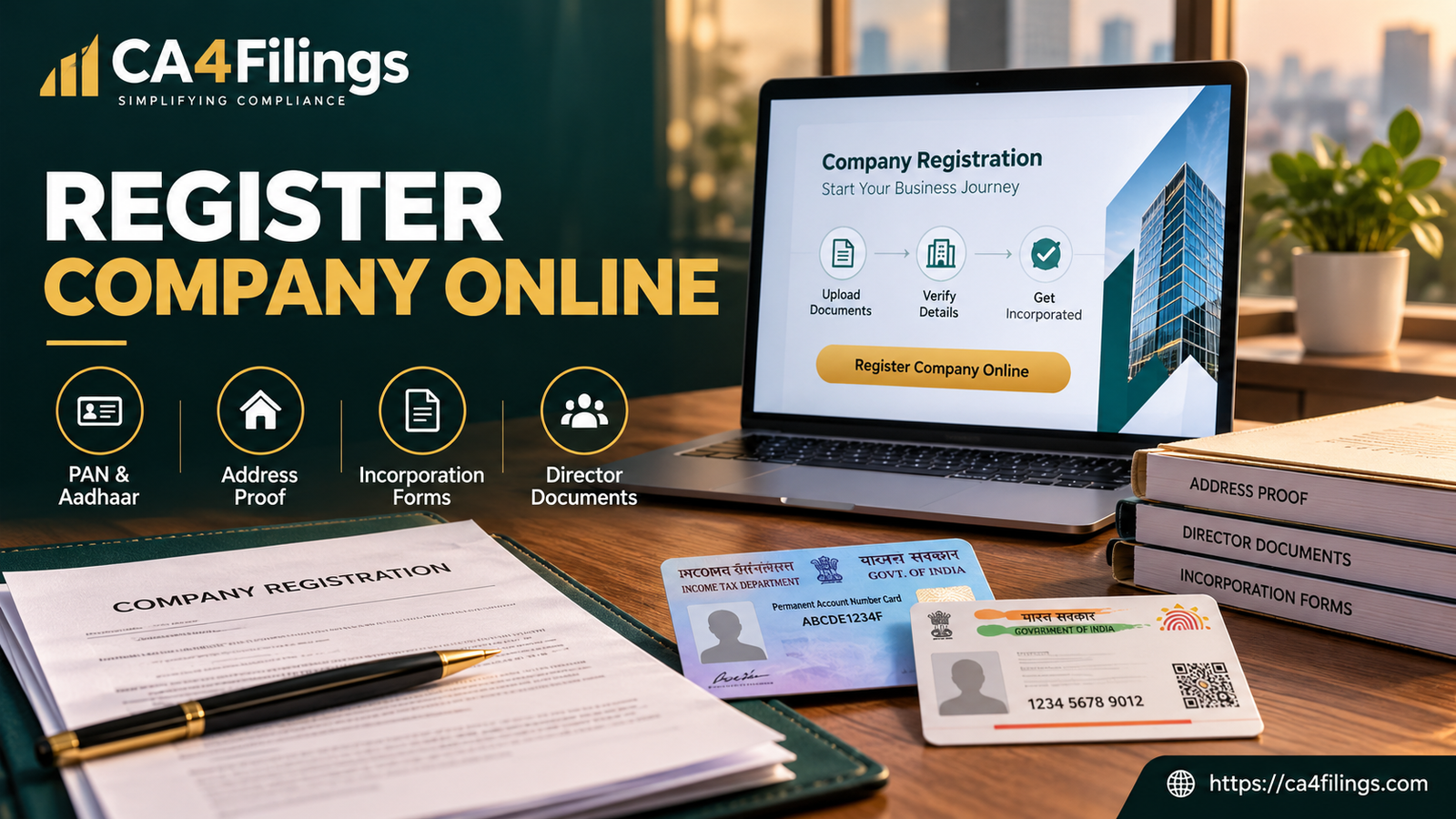
Starting a business is exciting, but paperwork can often make the first step feel complicated. The good news is that you do not need a huge stack of documents to register company online in India. With the right paperwork, a clear business structure, and proper guidance, the incorporation process can be much simpler than you expect.
At CA4Filings, we regularly guide entrepreneurs, freelancers, and small business owners through the documentation required to establish a legal business entity. Whether you are planning a micro business setup or launching a growing startup, understanding the essentials can help you avoid unnecessary delays. Our Company Registration services help business owners navigate the formalities and prepare the necessary documents correctly.
The key is knowing which documents are compulsory, which depend on your business structure, and how to prepare them before submitting your application.
What Documents Do You Need to Register Company Online?
In India, company incorporation is generally completed through the Ministry of Corporate Affairs (MCA) portal. For a private limited company, the process involves submitting prescribed incorporation forms, identity documents, address proofs, and declarations.
Here is the basic checklist most applicants should prepare.
1. PAN Card of All Proposed Directors
A Permanent Account Number (PAN) card is one of the most important documents for Indian directors and subscribers.
You will generally need:
A valid PAN card for each proposed Indian director.
PAN details matching the individual's official records.
Correct spelling of the name and date of birth.
CA4Filings tip: Even a small mismatch between the PAN details and the information entered in the incorporation forms can lead to resubmission requests. Check the details before filing rather than correcting them later.
For foreign nationals, different identity and tax-document requirements may apply.
2. Aadhaar Card or Other Identity Documents
Identity verification is another essential part of the process. Aadhaar is commonly used by Indian applicants, but it is not the only possible identity document.
Depending on the applicant and the applicable filing requirements, supporting identification may include:
Aadhaar card.
Passport.
Voter ID card.
Driving licence.
The acceptable documents depend on the person's nationality, identity verification requirements, and the specific form being filed. Ensure the documents are valid and legible.
3. Residential Address Proof of Directors
When you register company online, you must also provide the prescribed residential address proof for the proposed directors and subscribers, wherever required.
Common documents include:
Recent bank statements.
Electricity bills.
Telephone bills.
Other accepted residential address documents.
These documents generally need to be recent, commonly within the preceding two months for relevant incorporation filings. Always verify the current MCA requirements before submitting them.
For example, if a director recently moved to a rented flat, their PAN may show an older address. This does not automatically prevent incorporation, but the residential proof submitted must meet the applicable requirements.
4. Registered Office Address Proof
Every company must have a registered office address for official communication.
You may use an owned commercial property, a rented office, or another eligible premises, subject to applicable requirements.
Prepare the following documents as relevant:
Electricity bill, water bill, or another accepted utility bill for the premises.
Rent agreement or lease deed, if the property is rented.
No-objection certificate (NOC) from the property owner, where applicable.
Ownership proof or other supporting documents, where required.
The utility bill should generally be recent and reflect the address being declared.
Practical advice: Do not assume that a residential property cannot be used as a registered office. It may be possible, provided the premises and documentation satisfy applicable legal and local requirements.
5. Photographs and Contact Details
Photographs may be requested as part of supporting documentation or professional verification procedures. Keep recent photographs available if the filing professional or applicable process requires them.
You should also prepare:
Email addresses of the proposed directors.
Mobile numbers for verification and communication.
Complete residential and registered office addresses.
Accurate contact information helps prevent missed verification messages and unnecessary delays.
Additional Documents Depending on Your Company Structure
The documents required to register company online can vary according to the type of entity you choose. A private limited company, One Person Company (OPC), and other business structures do not necessarily follow identical requirements.
1. Digital Signature Certificate (DSC)
A Digital Signature Certificate is generally required for individuals who digitally sign the relevant incorporation forms.
The proposed directors or subscribers who need to sign electronically must obtain the appropriate DSC and complete the applicable verification process.
Keep in mind that a DSC is a digital signing credential, not simply another identity document.
2. Director Identification Number (DIN)
A Director Identification Number identifies an individual acting as a company director.
For eligible proposed directors who do not already have a DIN, the number can generally be allotted through the prescribed incorporation process, subject to the applicable rules and limits.
Existing directors should provide their correct DIN details.
3. Memorandum and Articles of Association
The Memorandum of Association (MOA) outlines the company's objectives and scope of activities, while the Articles of Association (AOA) establish its internal governance rules.
These documents are important because they define how the company operates legally.
Under the applicable incorporation process, electronic MOA and AOA forms are commonly used, although requirements may differ in certain circumstances.
4. Additional Declarations and Supporting Documents
Depending on the company structure and circumstances, the incorporation application may require:
Declarations by subscribers and proposed directors.
Consent to act as a director, where prescribed.
Details of share capital and shareholding.
Additional documents for foreign subscribers or corporate shareholders.
Certified or notarised documents where applicable.
Foreign documents may also require apostille, consularisation, or other formalities depending on the country and the applicable rules.
How to Register Company Online: Step-by-Step Process
Once your documents are ready, follow these steps to complete the incorporation process.
Step 1: Choose the right business structure.
Decide whether a private limited company, OPC, or another entity suits your business goals. Consider ownership, compliance obligations, liability, and future funding plans.
Step 2: Finalise the company name.
Choose a suitable name that meets MCA naming rules and does not conflict with existing company names or applicable trademarks.
Step 3: Arrange your DSC and supporting documents.
Collect identity proofs, address proofs, registered office documents, and other required information.
Step 4: Complete the incorporation forms.
Eligible applicants can use the MCA's prescribed online incorporation process, including SPICe+ and linked forms where applicable.
Step 5: Review and submit the application.
Check every detail before filing. Incorrect addresses, inconsistent names, or incomplete attachments can result in resubmission.
Step 6: Receive the incorporation documents.
After approval, the Registrar of Companies issues the Certificate of Incorporation. PAN and TAN are generally processed through the integrated incorporation system where applicable.
Remember that approval depends on the completeness and correctness of your application. Submission alone does not guarantee immediate incorporation.
Common Mistakes to Avoid During Online Company Registration
Many applicants face delays because of small, preventable errors.
Avoid these common mistakes:
Uploading unclear or incomplete document scans.
Using outdated residential or office address proofs.
Entering different spellings of a director's name across documents.
Submitting a rent agreement without required supporting documents.
Choosing a company name without checking availability.
Assuming every company structure requires exactly the same documents.
For entrepreneurs handling small startup legalities for the first time, a proper checklist is often more useful than collecting documents at random.
An online company registration tool can help organise the application process, but it cannot replace careful document verification. Similarly, a direct incorporation portal simplifies electronic filing, while corporate cloud filing solutions may help professionals manage records and compliance workflows. The documents themselves must still satisfy the applicable legal requirements.
Latest Updates
ca4filings.com Services

































