A Founder’s Timeline: How Long Does It Take to Register a Company Online?
Discover how long it takes to register company online in India, from DSC and name approval to incorporation, with expert tips from CA4Filings.
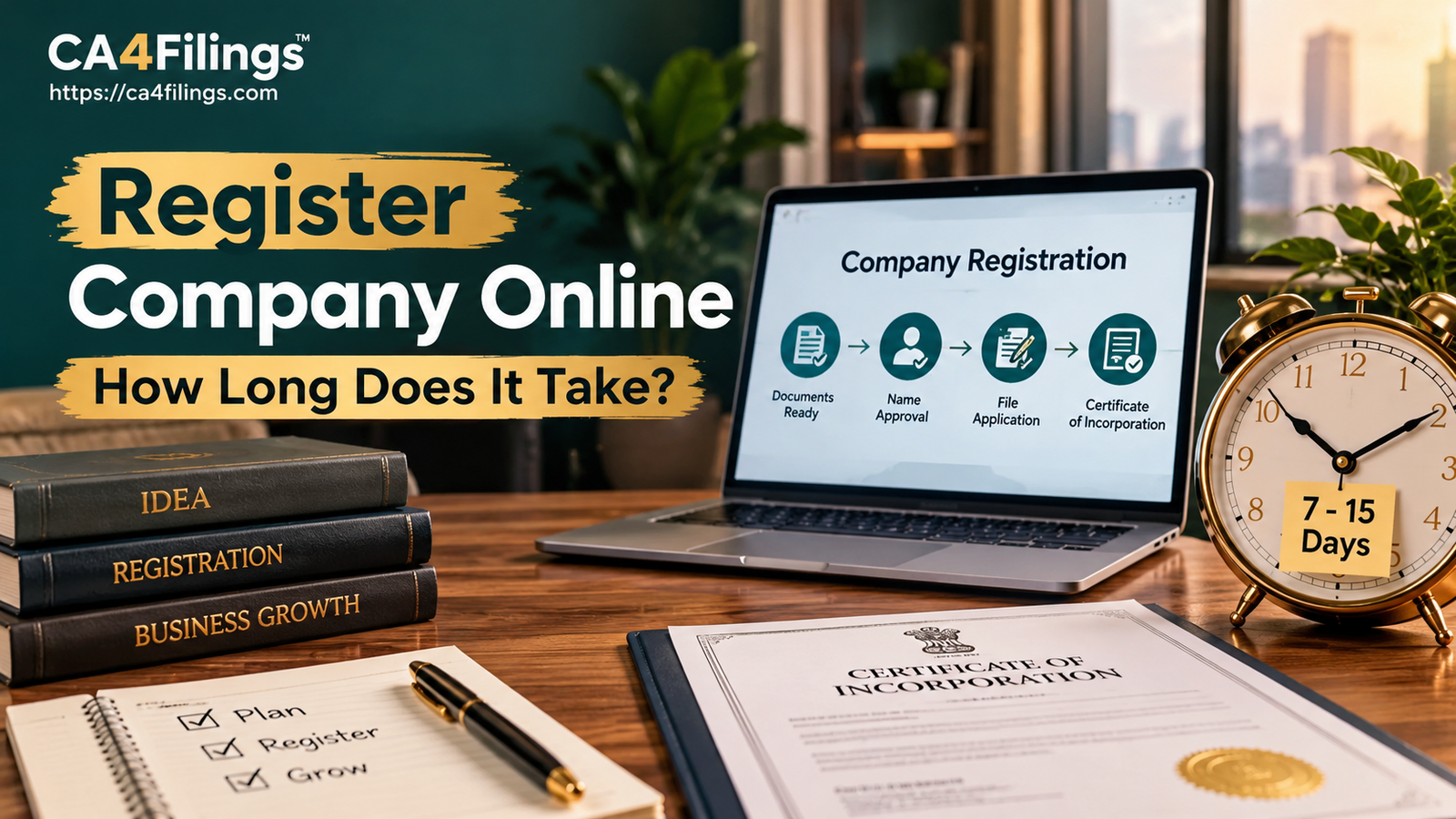
Starting a business is exciting, but before you welcome your first customer or sign a major contract, you need to establish your company legally. One of the first questions every founder asks is: how long does it take to register company online in India?
The good news is that India's digital incorporation process has made starting a business more convenient than ever. However, the actual timeline depends on document readiness, name approval, the type of business entity, and the Registrar of Companies (ROC) processing your application. If you are planning your launch, understanding the Company Registration process can help you set realistic expectations and avoid unnecessary delays.
At CA4Filings, we help entrepreneurs understand the practical steps involved in online entity registration. Here is a founder-friendly timeline covering each stage, common delays, and ways to complete your registration efficiently.
How Long Does It Take to Register Company Online in India?
In straightforward cases, a Private Limited Company can often be incorporated in approximately 7–15 working days, provided the documents are correct and the proposed name is acceptable. This is an indicative estimate, not a guaranteed government processing timeline.
The time required to register company online may vary depending on the following factors:
Document preparation: Whether directors have valid PAN, identity, and address proofs.
Digital Signature Certificate (DSC): How quickly the proposed directors obtain their digital signatures.
Company name approval: Whether the selected name meets MCA naming guidelines.
Government scrutiny: Whether the application requires clarification or resubmission.
Business structure: Whether you are forming a Private Limited Company, One Person Company (OPC), or another eligible entity.
For founders working towards a funding round, product launch, or client contract, starting the process early can prevent avoidable scheduling problems.
A Founder’s Timeline: Step-by-Step Company Registration
Day 1–2: Prepare Your Documents
The first step is collecting and checking the required documents. In our experience, incomplete paperwork is one of the most avoidable causes of delay.
Typically, Indian directors and subscribers need:
PAN card and valid identity proof.
Address proof, such as a bank statement or utility bill, where applicable.
Recent photographs, if required for the process.
Email addresses and mobile numbers for verification.
Proof of the proposed registered office, such as a utility bill and ownership or rental documents, as applicable.
A No Objection Certificate (NOC) from the property owner, where required.
Foreign nationals or non-resident directors may need additional documents, including notarisation, apostille, or consular authentication, depending on the country and applicable requirements.
CA4Filings tip: Ensure names and addresses match across documents. Even a small discrepancy can lead to additional verification or resubmission.
Day 2–3: Obtain a Digital Signature Certificate
A Digital Signature Certificate (DSC) allows proposed directors and authorised signatories to digitally sign incorporation documents filed with the Ministry of Corporate Affairs (MCA).
The time required depends on the identity verification process and the completeness of the applicant's information. Having the necessary identity and contact details ready can help avoid unnecessary back-and-forth.
Because the incorporation process is digital, a valid DSC is an important part of completing official company registration smoothly.
Day 3–5: Apply for Company Name Approval
Your proposed company name must comply with MCA rules and should not be identical or too similar to an existing company or registered trademark in a way that violates applicable requirements.
Founders should prepare two or more suitable name options and check for potential conflicts before applying.
For example, a founder launching a technology consultancy may prefer a distinctive name rather than a generic name that resembles several existing businesses.
A name application may be processed relatively quickly, but objections, trademark concerns, or requests for clarification can extend the timeline. A rejected name means additional work before incorporation can proceed.
Day 4–8: File the Incorporation Application
Once the necessary details and approvals are available, the incorporation application is prepared and submitted through the applicable MCA process, generally using the SPICe+ system and linked forms where required.
The application captures information such as:
Proposed company name and business activities.
Details of directors and shareholders.
Registered office information.
Authorised and subscribed share capital.
Applicable declarations and supporting documents.
The MCA may examine the submission and request clarification if information is missing or inconsistent. Promptly addressing such requests helps prevent unnecessary delays.
For founders seeking fast business incorporation, professional document review before filing can make a meaningful difference.
Day 7–15: Receive the Certificate of Incorporation
After the application is approved, the Registrar of Companies issues the Certificate of Incorporation. The certificate confirms that the company has been legally incorporated.
Depending on the applicable process and eligibility, the incorporation package also covers associated registrations such as PAN and TAN.
Once the certificate is issued, founders can move forward with important operational tasks, including opening a current account, completing banking formalities, and preparing for business operations.
Remember that incorporation does not automatically complete every compliance requirement. GST registration, sector-specific licences, and other registrations may still be necessary depending on your activities.
What Can Delay Your Online Company Registration?
Even a well-planned application can take longer than expected. The most common reasons include:
Incorrect or inconsistent director information.
Incomplete registered office documentation.
Rejection or resubmission of the proposed company name.
Missing signatures or declarations.
Additional scrutiny by the ROC.
Delays in obtaining documents from overseas directors.
Public holidays or other administrative delays.
To improve your chances of completing online entity registration on time, verify every document before submission and respond quickly to official queries.
How Can Founders Register a Company Online Faster?
If you want a smoother incorporation experience, follow these practical steps.
Step 1: Choose the right business structure. Consider whether a Private Limited Company, OPC, or another structure best fits your ownership, funding, and operational requirements.
Step 2: Keep documents ready. Collect identity proofs, address proofs, and registered office documents before starting the application.
Step 3: Select a distinctive name. Check the MCA database and relevant trademark records to identify potential conflicts.
Step 4: Review the application carefully. Ensure that director details, shareholding information, and business activities are consistent across the forms.
Step 5: Seek professional assistance. An experienced professional can help identify documentation gaps and explain applicable digital corporate legalities.
Step 6: Plan post-incorporation compliance. Consider banking, GST applicability, accounting, statutory registers, and other obligations relevant to your new startup structure.
These steps cannot guarantee approval within a fixed number of days, but they can reduce avoidable errors and improve the overall process.
What Happens After You Receive Your Business Certificate Online?
Receiving your Certificate of Incorporation is an important milestone, but it is not the end of your responsibilities as a founder.
After incorporation, consider the following actions:
Open a company bank account and complete the bank's verification requirements.
Arrange for share capital to be received and documented as applicable.
Issue share certificates within the prescribed period.
Appoint an auditor within the statutory timeline.
Complete applicable commencement-of-business requirements, including Form INC-20A where relevant.
Register for GST if your business is required to do so.
Maintain accounting records and meet applicable ROC filing deadlines.
Your Certificate of Incorporation serves as official evidence that the company exists as a legal entity. However, the expression business certificate online should not be confused with every licence or registration your business may require.
The exact obligations depend on your company type, business activities, and applicable law.
Latest Updates
ca4filings.com Services

































