Step-by-Step Legal Procedure for Section 8 Company Registration
Planning to start a non-profit? Follow our comprehensive guide to section 8 company registration and ensure your organization is legally compliant.
Starting a non-profit organization is a noble endeavor, but navigating the regulatory landscape can feel overwhelming for many social entrepreneurs. At CA4Filings, we often see passionate individuals get stuck in the procedural maze, which is why we emphasize the importance of getting your foundational documentation right. Whether you are launching a startup or a traditional business entity, choosing the right structure is key, and you can explore our Company Registration services to see which model best fits your vision. For those dedicated to social welfare, arts, or education, the section 8 company registration process is the gold standard for credibility and transparency.
In this guide, I will break down the legal journey of establishing a non-profit, helping you understand the nuances of section 8 company registration so you can focus on your cause rather than the paperwork.
Understanding Section 8 Companies
Before jumping into the filings, it is essential to understand what makes this entity unique. Unlike a private limited company, a Section 8 company is governed by the Companies Act, 2013, and is specifically designed to promote commerce, art, science, sports, education, research, social welfare, religion, charity, or environmental protection.
The primary characteristic of this structure is that the profits are applied solely for the promotion of the company’s objectives, and no dividends are paid to its members. From my experience as a CA, clients choose this route because it offers a corporate identity, perpetual succession, and higher public trust compared to a Trust or a Society.
Eligibility Criteria for Section 8 Company Registration
To qualify for section 8 company registration, the Ministry of Corporate Affairs (MCA) maintains strict government licensing standards. You must meet these specific criteria:
The entity must have a clear charitable objective.
It must intend to use its surplus solely for the promotion of its objects.
It must prohibit the payment of any dividend to its members.
It must be able to demonstrate a sound business plan that outlines how the organization will serve the public interest.
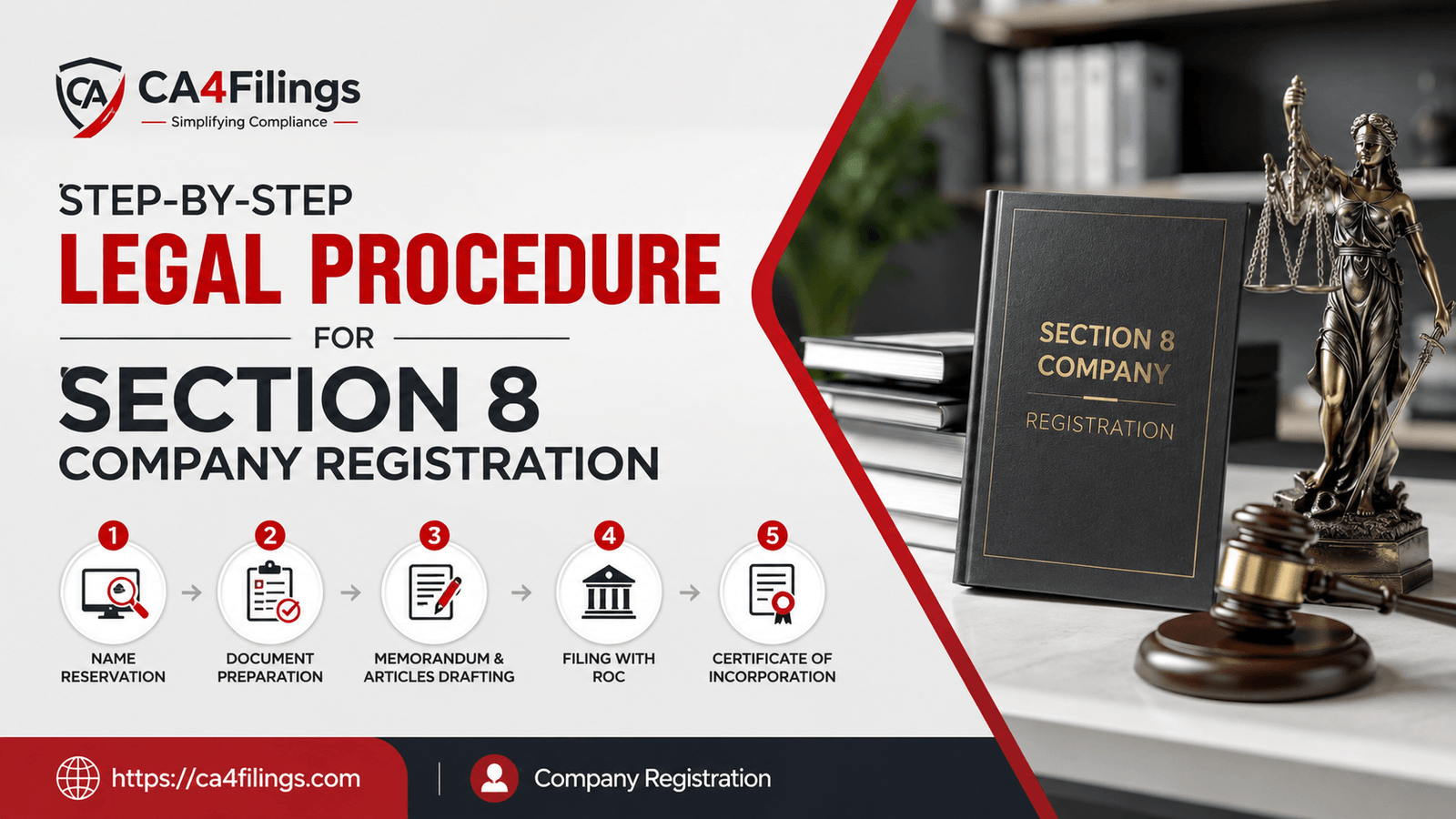
Step-by-Step Procedure for Section 8 Company Registration
The process of section 8 company registration is entirely online, managed via the MCA’s V3 portal. Here is how we at CA4Filings typically navigate the process for our clients.
Step 1: DSC and DIN Acquisition
Every director must obtain a Digital Signature Certificate (DSC). If the proposed directors do not have a Director Identification Number (DIN), we initiate the application during the incorporation process itself.
Step 2: Name Approval via RUN
The company name must be unique and suggestive of its non-profit nature. We use the Reserve Unique Name (RUN) service or include the name reservation in the SPICE+ form. Remember, names like "Foundation," "Association," or "Council" are commonly used for section 8 company registration to signal their purpose to the public.
Step 3: Drafting the MOA and AOA
This is the most critical phase. Proper moa drafting for ngos requires immense precision. You must explicitly mention the charitable objects clause to ensure the Registrar of Companies (ROC) is satisfied that your intent is strictly non-profit. Any ambiguity here can lead to delays in receiving your license.
Step 4: Applying for the Section 8 License
Unlike a standard company, you need a specific license under Section 8(1) of the Companies Act. This involves filing Form INC-12. This is where you submit your detailed project report, which justifies why the entity should be granted non-profit status.
Step 5: Final Incorporation (SPICE+)
Once the license is approved, we file the integrated SPICE+ form along with the mandatory declarations, registered office proof, and subscriber details. Once the ROC verifies these license applications, the Certificate of Incorporation is issued.
Challenges in Non-Profit Incorporation
One of the common hurdles in non-profit incorporation is the scrutiny applied to the "Objects Clause." If the ROC feels the objects are too broad or could lead to commercial gain, they will issue a query. As a professional, I always advise my clients to be hyper-specific. Don't just say "we want to help people"; define the beneficiaries, the methodology, and the geographical reach.
Frequently Asked Questions
Is it mandatory to have two directors for a Section 8 company?
Yes, you need a minimum of two directors. They can be individuals or corporate bodies.
Can a Section 8 company convert into another type of company?
Yes, it is possible to convert a Section 8 company into a private or public limited company, but the process is complex and requires strict adherence to legal provisions and public notice requirements.
Does the company need to pay income tax?
A Section 8 company is a separate legal entity and is subject to the Income Tax Act. However, you can apply for registration under Section 12AB and 80G to claim tax exemptions, which is a major advantage of section 8 company registration.
How long does the registration take?
Typically, if the documentation is perfect, the entire process takes about 30 to 45 days, depending on the speed of government approvals.
Let CA4Filings Support Your Mission
Embarking on the journey of section 8 company registration is a significant milestone for any social entrepreneur. While the legal requirements are rigorous, the outcome—a professional, transparent, and legally recognized non-profit—is worth the effort.
At CA4Filings, we specialize in simplifying these complex regulatory processes. From drafting the perfect charitable objects clause to handling your final license applications, our team ensures your incorporation is seamless. Don't let paperwork stall your impact. Contact CA4Filings today, and let’s turn your vision into a legally compliant reality!
Latest Updates
ca4filings.com Services























-registration.png)