Section 8 Company Registration vs. Trust vs. Society: The Definitive Comparison
Choosing between a Section 8 company, Trust, or Society? Get our expert breakdown on section 8 company registration to make the right choice today.
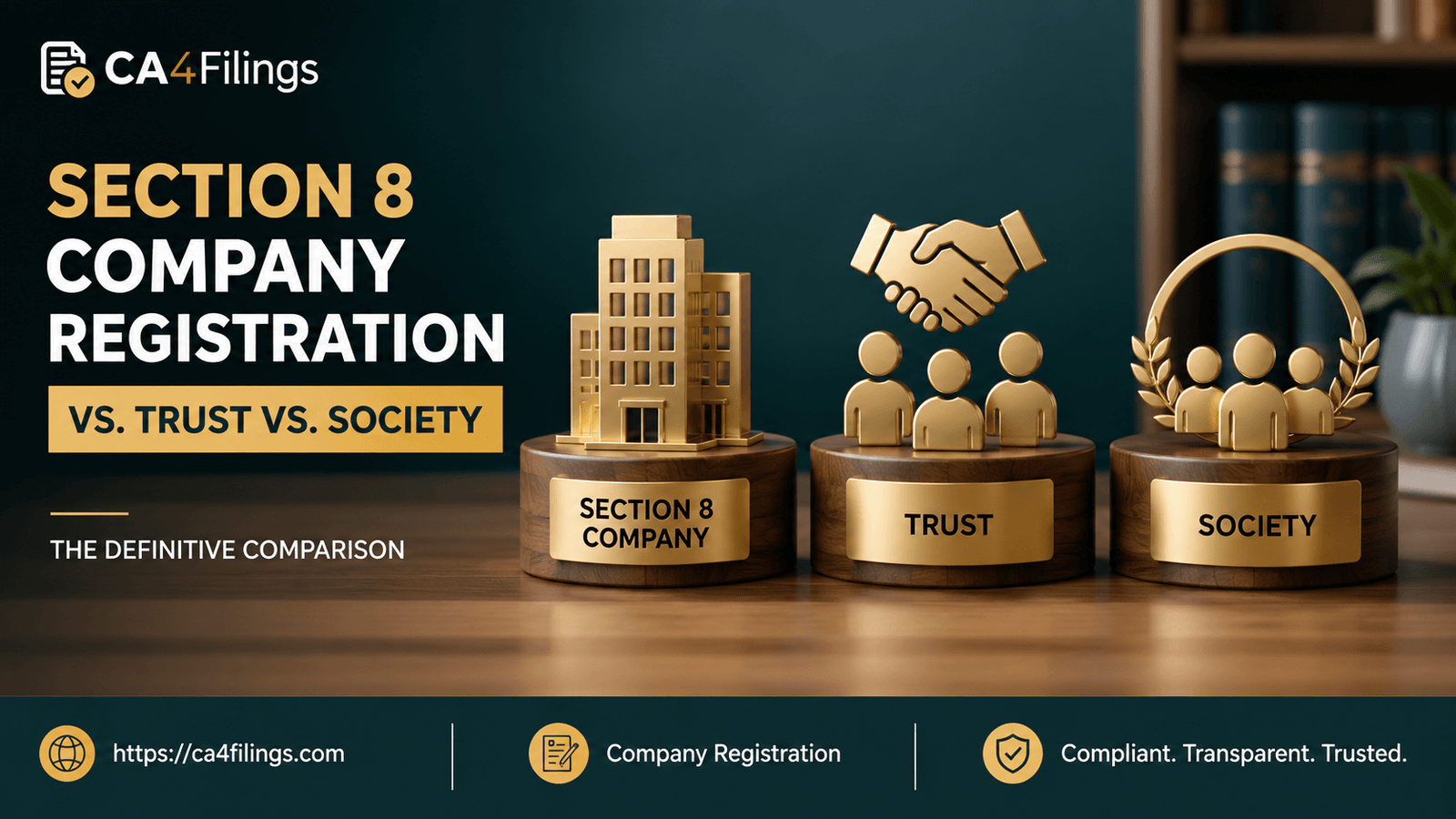
Starting a non-profit organization is a noble endeavor, but navigating the legal landscape in India can often feel like a maze. Whether you are driven by a cause for education, healthcare, or social welfare, choosing the right legal structure is the most critical first step. Many of our clients at CA4Filings often ask us about the best path to formalize their mission, and while we offer a comprehensive Company Registration service, the choice between a Section 8 company, a Trust, or a Society depends heavily on your long-term goals. Understanding the intricacies of section 8 company registration is vital because your structure dictates your ability to scale, your tax benefits, and your credibility with donors.
In this guide, we will break down these three entities to help you decide which one aligns best with your vision.
Understanding the Landscape: Why Structure Matters
Before diving into section 8 company registration, it is important to recognize that India offers distinct vehicles for non-profits. A Trust is generally created for a specific purpose or for the benefit of specific individuals/the public. A Society is an association of people formed for the promotion of literature, fine arts, or science. However, if you want a professional, corporate-style setup that commands respect, a Section 8 company is often the preferred route.
The primary difference lies in the structural transparency and corporate administration. While Trusts and Societies are governed by state-specific laws, a Section 8 company is governed by the Companies Act, 2013, falling under the purview of the Ministry of Corporate Affairs (MCA). This central oversight provides a level of legitimacy that is highly regarded by international organizations.
What is a Section 8 Company?
A Section 8 company is a private limited company that is licensed to operate as a non-profit. It is designed to promote commerce, art, science, sports, education, research, social welfare, religion, charity, or environmental protection.
Key Advantages of Section 8 Company Registration
Distinct Legal Identity: Like any corporate body, it has a separate legal existence from its promoters.
Credibility: Because of the rigorous compliance auditing required by the Companies Act, donors view these entities as more reliable.
Funding Accessibility: It is easier to secure grants and corporate social responsibility (CSR) funds, making section 8 company registration a popular choice for serious ventures.
Global Donor Trust: International agencies and large-scale funders prefer the corporate structure of a Section 8 company due to its clear governance and accountability.
Section 8 Company vs. Trust vs. Society: A Comparison
When you compare these non-profit entity variations, you must look at the administrative burden and the governing laws.
| Feature | Section 8 Company | Trust | Society |
|---|---|---|---|
| Governing Law | Companies Act, 2013 | Indian Trusts Act, 1882 | Societies Registration Act, 1860 |
| Registration | Central (MCA) | State | State |
| Membership | Minimum 2 directors | Minimum 2 trustees | Minimum 7 members |
| Governance | High transparency | Moderate | Moderate |
| Compliance | Strict annual filings | Flexible | State-dependent |
The Trust Model
Trusts are often used for private family matters or specific charitable purposes. They are simple to register but lack the formal structure that larger projects might require. If you are looking to build a large-scale NGO with multiple branches, a Trust might feel too informal as you grow.
The Society Model
Societies are essentially associations of people. They work well for local initiatives, sports clubs, or neighborhood groups. However, the internal politics can sometimes become a hurdle, and the lack of a standardized national framework makes section 8 company registration look more attractive to those aiming for national or international impact.
Practical Insights for Your Choice
If you are just starting out, ask yourself: What is my ultimate objective?
If you plan to collaborate with international NGOs or seek CSR funding from large corporations, the corporate discipline of a Section 8 company is your best bet. At CA4Filings, we often tell our clients that while the initial documentation for section 8 company registration might seem more detailed, it saves you from "compliance headaches" later on. Because these companies are audited under a centralized system, you are less likely to face disputes regarding your financial statements or board management compared to a Society.
Compliance Auditing and Sustainability
One of the most significant reasons to choose a Section 8 company is the ease of management. The Companies Act provides a clear roadmap for meetings, accounting, and filings. In the world of non-profits, trust is your currency. Having a structured setup ensures that your compliance auditing is straightforward, which in turn boosts your funding accessibility. Donors want to know that their money is being handled with professional rigor.
Frequently Asked Questions (FAQs)
1. Is section 8 company registration costlier than a Society?
Generally, yes. The process involves professional fees and government charges related to the MCA filing. However, the long-term benefits in terms of credibility and funding often outweigh the initial cost.
2. Can a Section 8 company pay dividends?
No. All profits must be applied towards the promotion of the company’s objectives. No dividend is paid to its members.
3. Which entity is best for CSR funding?
A Section 8 company is widely considered the best structure for receiving CSR funds from Indian corporations because of its professional and transparent administrative setup.
4. How long does the registration process take?
With the current digital processes in India, section 8 company registration typically takes about 30 to 45 days, depending on the accuracy of your documentation and government processing times.
5. Can I convert a Society into a Section 8 company later?
Yes, it is legally possible to convert an existing NGO into a Section 8 company, though it involves specific procedural steps under the Companies Act.
Partner with CA4Filings for Your Vision
Choosing the right structure is the foundation of your success. Whether you decide that section 8 company registration is the way to go or you need assistance evaluating the nuances of a Trust, CA4Filings is here to provide the expertise you need. We handle the paperwork, compliance, and legal formalities so that you can focus entirely on the impact you want to create in society.
Latest Updates
ca4filings.com Services
























-registration.png)