How to Registration Company Licenses: Local, State, and Federal Requirements
Learn how to registration company licenses across local, state and federal levels, including permits, tax licences, zoning and compliance needs.
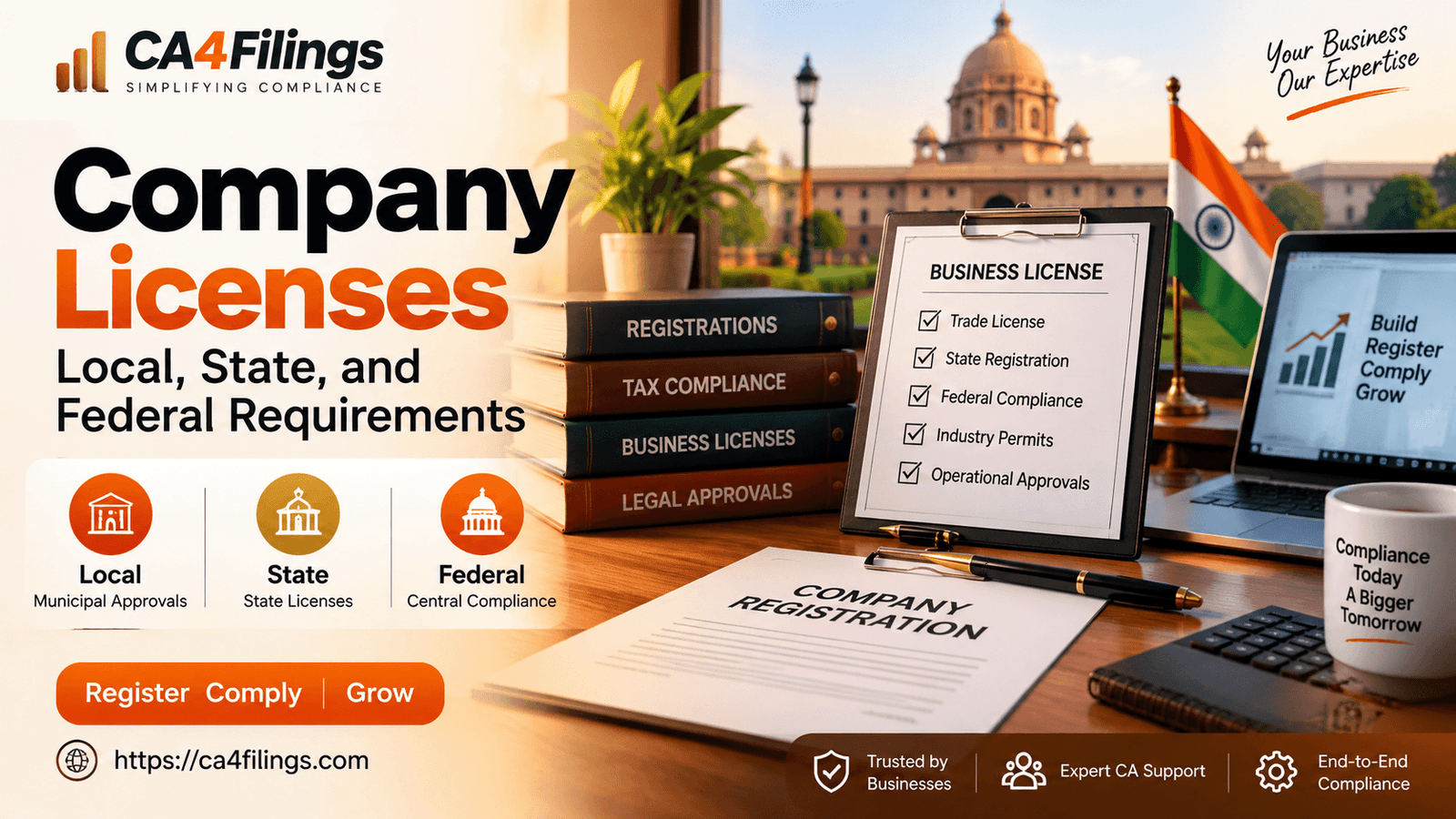
Starting a business involves much more than choosing a name and registering an entity. Many entrepreneurs searching for how to registration company requirements are surprised to learn that company incorporation is only the beginning. Depending on the nature and location of your business, you may also need tax registrations, local permissions, industry-specific licences and operational approvals. If you are planning your formal setup, understanding Company Registration and the licences that follow can help you avoid unnecessary compliance problems.
For Indian entrepreneurs, the phrase “federal requirements” generally refers to requirements imposed at the central or national level. India does not use the federal licensing structure found in countries such as the United States. Instead, businesses may have to comply with central, state and municipal authorities. The right approach to how to registration company licensing is therefore to identify every approval applicable to your business before commencing operations.
How to Registration Company Licenses: Start With Your Business Activity
The first step is not filling out an application. It is identifying exactly what your business does.
A software development company, restaurant, manufacturing unit and healthcare business can have completely different licensing requirements. Even two businesses operating in the same city may require different approvals because their activities, premises and workforce differ.
Before applying for licences, make a basic compliance checklist covering:
- Nature of business and products or services
- Registered business structure
- State and city of operation
- Physical office, shop, warehouse or factory
- Number of employees
- Customer-facing activities
- Use of machinery or specialised equipment
- Environmental impact
- Food, healthcare or other regulated activities
This simple assessment makes how to registration company licensing much easier because you know which authorities need to be approached.
How to Registration Company Requirements at the Central Level
Certain registrations and approvals operate at the national level in India. These can apply regardless of the city in which your business operates.
Tax and Business Registrations
Depending on turnover, business activity and applicable law, you may need registrations such as:
- GST registration
- PAN and TAN-related registrations
- Import Export Code for eligible import/export activities
- Employee-related registrations where applicable
- Sector-specific registrations or approvals
A sales tax license is a term commonly used in other jurisdictions. In India, GST has largely replaced the older state-level sales tax framework for most goods and services, although businesses should still verify whether any particular local or state tax obligation applies to their activity.
Industry-Specific Approvals
Certain industries have additional regulatory requirements. For example, a food business may require food-related registration or licensing, while a manufacturing business could require pollution-control approvals and factory-related permissions.
The important lesson in how to registration company compliance is that incorporation does not automatically give you permission to conduct every type of commercial activity.
State-Level Licenses and Registrations
State governments can impose additional requirements depending on the business activity and location.
For example, businesses may encounter requirements relating to:
- Shops and commercial establishments
- Professional or employment-related compliance
- Labour regulations
- State-specific tax requirements
- Factory operations
- Fire and safety approvals
- Sector-specific permissions
A business owner should check the rules of the particular state rather than relying on a checklist prepared for another state.
Why Location Matters
Consider an entrepreneur opening a small manufacturing facility. The company may be properly incorporated, but that does not necessarily mean the premises are authorised for manufacturing.
This is where zoning compliance becomes important. Although “zoning” is more commonly associated with foreign regulatory terminology, the underlying concept exists in India through local development rules, land-use regulations and municipal permissions.
Local Licenses: Municipal Codes and Operational Permissions
Local authorities often control the permissions that allow a business to operate from a particular premises.
Municipal requirements may include:
- Trade licences
- Shop and establishment permissions
- Building and occupancy-related approvals
- Signage permissions
- Fire safety requirements
- Waste-management permissions
- Local health-related approvals
Businesses should also consider municipal codes, which can govern how commercial premises are used and what activities are permitted at a particular location.
For example, a restaurant may need local trade permissions and health-related approvals in addition to its business registration. A manufacturing facility may face more extensive local requirements concerning construction, waste and safety.
Occupational License and Professional Activities
Some professions and regulated activities require specific authorisation before services can be offered.
An occupational license may be relevant in jurisdictions where professionals must obtain permission to practise a particular occupation. In India, the exact requirement depends heavily on the profession and the applicable regulator.
Entrepreneurs should therefore ask:
- Is my profession regulated?
- Does my state have a separate professional requirement?
- Does my business need approval from a professional or sector regulator?
- Does each individual practitioner require separate registration?
This distinction is particularly important for consultants, healthcare providers, financial professionals and other regulated service providers.
Health Department Permit and Environmental Permits
Businesses dealing with food, public health, chemicals, manufacturing or waste may have additional regulatory obligations.
A health department permit may be relevant to businesses involving food preparation, sanitation or public-facing health concerns, depending on local regulations.
Similarly, environmental permits or approvals can become important where business activities generate emissions, discharge, hazardous waste or other environmental impacts.
A common mistake is waiting until the business is ready to open before checking these requirements. Some permissions can involve inspections, documentation and coordination with multiple authorities, so planning ahead is essential.
How to Registration Company Licenses Step by Step
A practical approach can save both time and compliance costs.
Step 1: Define the Business
Clearly document your products, services, premises and operational activities.
Step 2: Identify the Business Structure
Determine whether a proprietorship, partnership, LLP or company is suitable for your circumstances.
Step 3: Identify Applicable Authorities
Separate your requirements into:
- Central-level registrations
- State-level registrations
- Local or municipal permissions
- Industry-specific approvals
Step 4: Check Premises Requirements
Before signing a long-term lease, verify whether the property can legally be used for your intended commercial activity.
Step 5: Apply for Licenses
Prepare documents such as identity proofs, business documents, address proof, property documents, photographs and technical information wherever required.
Step 6: Track Renewals and Changes
Some licences require periodic renewal, while others may need modification when the business changes its address, ownership, activity or capacity.
Common Mistakes Business Owners Should Avoid
When researching how to registration company licences, entrepreneurs often focus only on incorporation and tax registration. Other common mistakes include:
- Starting operations before obtaining required permissions
- Assuming one licence covers every business activity
- Ignoring local authority requirements
- Using a commercial property without checking permitted use
- Missing renewal deadlines
- Applying under incorrect business activity classifications
- Failing to maintain copies of licences and approvals
Professional guidance can help identify gaps before they become expensive compliance issues.
FAQs About How to Registration Company Licenses
Is company registration the same as getting a business licence?
No. Company registration creates or formally establishes the business entity. Licences and permits provide permission to conduct particular activities or operate under specific regulations.
Does every company need a trade licence?
Not necessarily. The requirement depends on the business activity, premises and local authority rules. A business should check its specific municipal requirements.
What is the difference between central, state and local licences?
Central requirements generally arise from national laws and regulators. State requirements are administered by state authorities, while local permissions are generally connected with municipal or local bodies.
Does a small business need environmental approvals?
It depends on its activities. Businesses involving manufacturing, emissions, waste, chemicals or other potentially regulated activities may have environmental compliance requirements.
Can licences be obtained after company incorporation?
Yes, many licences are obtained after incorporation, but the correct sequence depends on the business. Some approvals may be required before operations begin, so planning the entire compliance process is important.
How to Registration Company Compliance the Right Way
Understanding how to registration company requirements means looking beyond incorporation. A legally established business may still require central, state, municipal and industry-specific permissions before it can operate smoothly.
At CA4Filings, we help entrepreneurs approach business setup with a compliance-first mindset. From understanding applicable registrations to identifying licensing requirements and documentation, the objective is simple: help you establish your business correctly and reduce avoidable compliance complications.
If you are planning a new venture or expanding an existing business, connect with CA4Filings for professional guidance on your registration and regulatory requirements.
Latest Updates
ca4filings.com Services

























-registration.png)