E-Commerce Setup: Why a Private Limited Company Registration Is Mandatory for Scale
Discover why private limited company registration helps e-commerce businesses build trust, meet platform requirements, attract investors, and scale across India.
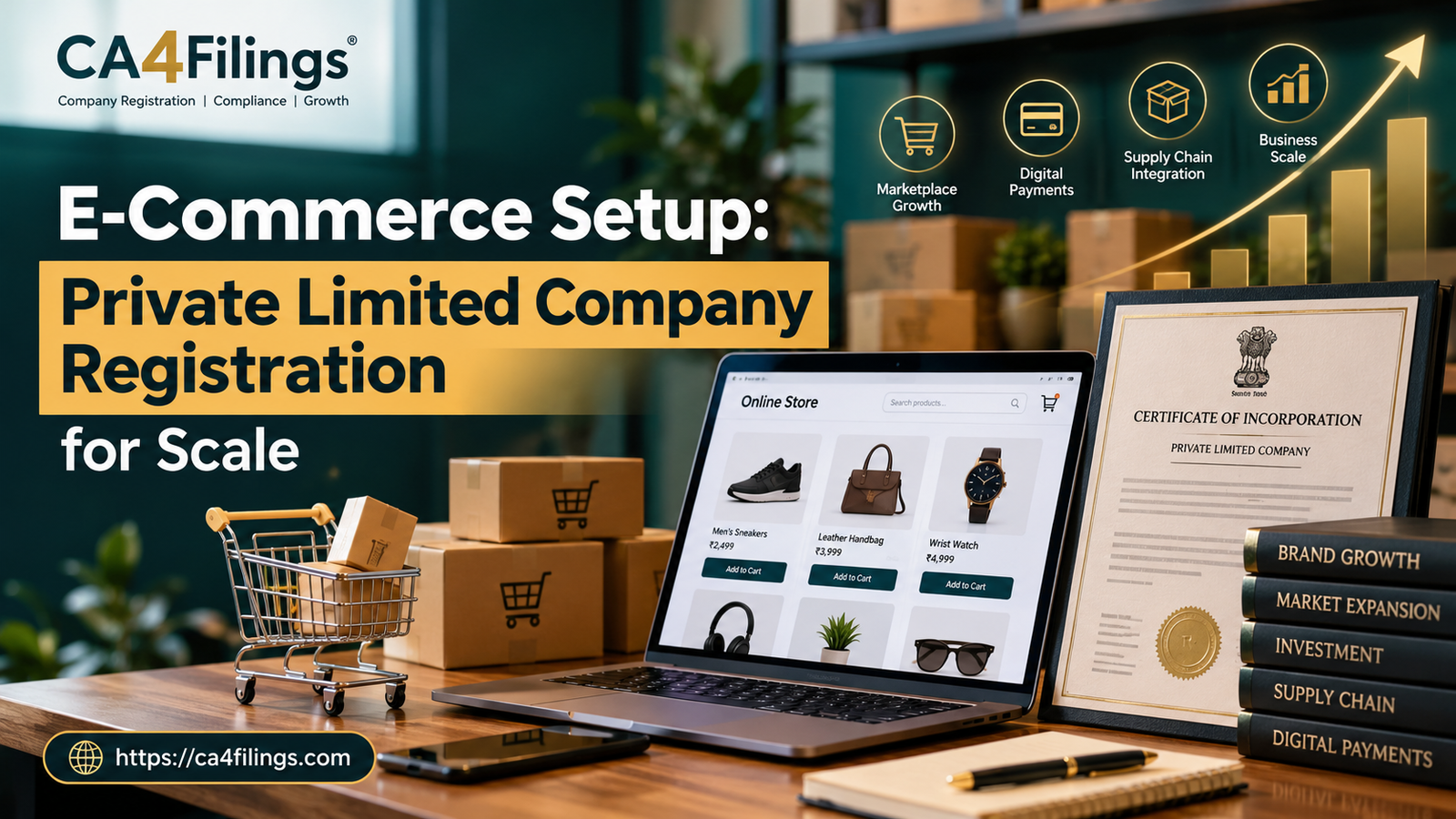
Starting an e-commerce business in India is easier than ever. Entrepreneurs can sell through marketplaces, launch independent websites, accept online payments, and reach customers across the country without investing in traditional retail setups. However, as sales grow, informal business structures can create challenges in banking, compliance, vendor relationships, and expansion. This is where private limited company registration becomes an important step towards building a scalable business.
At CA4Filings, we often see entrepreneurs focus on products, advertising, and customer acquisition while overlooking the legal structure behind their business. Choosing the right structure through Company Registration can help establish a professional foundation for long-term growth. Although a private limited company is not legally mandatory for every e-commerce seller, it offers several advantages when a business plans to expand, raise funds, or build a recognised brand.
Let us understand why this structure is particularly useful for ambitious e-commerce businesses and when entrepreneurs should consider making the transition.
Why Private Limited Company Registration Matters for E-Commerce Businesses
An e-commerce business may begin with a few products and a small customer base. As orders increase, the owner must manage suppliers, payment providers, employees, inventory, taxes, and customer expectations.
A private limited company creates a separate legal identity from its owners. It can own assets, enter into contracts, open business bank accounts, and conduct operations in its own name.
Here are the major advantages:
Separate legal identity: The company is legally distinct from its shareholders.
Limited liability: Shareholders generally have limited liability, subject to applicable law and exceptions such as personal guarantees or misconduct.
Professional credibility: Suppliers, payment providers, and business partners may find a formally incorporated entity easier to evaluate.
Structured ownership: Shares make it easier to define ownership and bring in new investors.
Expansion opportunities: A company structure can support additional product lines, distribution arrangements, and larger business operations.
For founders who want to build a long-term e-commerce brand rather than operate a small side business, these benefits can make a meaningful difference.
Is Private Limited Company Registration Mandatory for Selling Online?
This is one of the most common questions entrepreneurs ask.
The short answer is no, not for every e-commerce business. Indian law does not universally require every online seller to incorporate a private limited company. Depending on the business model and applicable requirements, an entrepreneur may operate as a sole proprietor, partnership, LLP, or company.
However, specific marketplaces, payment providers, commercial partners, or business arrangements may impose their own onboarding and documentation requirements.
For example, a founder selling handmade products through social media may begin as a sole proprietor, subject to applicable tax and registration rules. In contrast, a business planning to sell nationally, hire a large team, introduce multiple shareholders, and raise external funding may benefit from incorporation much earlier.
Before choosing a structure, consider:
Your expected annual turnover and growth plans.
Whether you intend to raise investment.
The documentation required by your chosen marketplace.
Your exposure to contractual and operational risks.
The ongoing cost of accounting, tax filings, and company compliance.
The goal is not to incorporate simply because other sellers have done so. It is to select a structure that matches your business objectives.
5 Reasons Private Limited Company Registration Supports Business Growth
1. Easier Marketplace Seller Onboarding
Marketplace seller onboarding often involves verifying the seller's identity, business details, bank account, tax registrations, and product-related documents. Requirements vary across platforms and business categories.
A private limited company provides a formal business identity that can simplify documentation and establish consistency across commercial records.
For example, a skincare brand planning to sell through multiple marketplaces may need to coordinate its business PAN, GST details, bank account, invoices, and brand documents. Maintaining these records under one incorporated entity can make the process more organised.
Remember, incorporation alone does not guarantee marketplace approval. Each platform has its own eligibility criteria.
2. Smoother Integration with Digital Payment Gateways
As online sales increase, businesses need dependable payment collection and settlement systems. Digital payment gateways may request business verification, bank details, ownership information, and other compliance documents before activating or expanding merchant services.
Private limited company registration helps establish a formal entity for entering into payment-related agreements and maintaining clear financial records.
It also encourages better separation between personal and business finances. This is particularly valuable when reconciling refunds, chargebacks, payment settlements, advertising expenses, and supplier payments.
3. Better Opportunities for Funding and Investment
A business aiming to scale may eventually need capital for inventory, marketing, warehousing, technology, or hiring.
Private limited companies can issue shares and accommodate equity investors through appropriate legal procedures. This makes the structure attractive to angel investors, venture capital firms, and strategic partners.
Consider an online fashion business generating consistent monthly revenue. Its founder may want to raise funds to launch new collections and expand into additional cities. A company structure can provide a defined framework for investor ownership, shareholder rights, and corporate governance.
However, funding is never guaranteed. Investors will also examine profitability, customer acquisition costs, market demand, financial records, and the strength of the management team.
4. Stronger Brand Authorization and Supplier Relationships
Building a recognised brand requires more than attractive packaging and advertising. Suppliers, distributors, manufacturers, and authorised resellers need clarity about who they are dealing with.
An incorporated entity can enter into contracts, purchase inventory, appoint distributors, and document brand authorization arrangements in its own name.
For instance, an electronics seller sourcing products from an authorised distributor may need to provide business documentation and comply with the distributor's commercial terms. A properly structured company can support these relationships as operations expand.
Founders should also consider trademark protection, product certification, labelling rules, and sector-specific licences wherever applicable.
5. Improved Supply Chain Integration
Growing e-commerce businesses often move from small, manually managed operations to organised supply chains involving third-party logistics providers, warehouses, manufacturers, and distributors.
Private limited company registration provides a formal entity for negotiating commercial contracts and establishing standard purchasing and invoicing processes.
It can be especially useful when businesses expand across states, introduce wholesale distribution, or operate alongside offline retail setups.
A clear ownership structure and reliable financial reporting also help management evaluate inventory turnover, supplier credit periods, operating costs, and working capital requirements.
How to Complete Private Limited Company Registration in India
The incorporation process should be planned carefully to avoid documentation errors and unnecessary delays.
Follow these steps:
Step 1: Select the company name
Choose a distinctive name that reflects your business and complies with applicable naming rules. Check availability before proceeding.
Step 2: Identify directors and shareholders
A private limited company generally requires at least two members and two directors, with at least one director meeting the applicable Indian residency requirement.
Step 3: Arrange the required documents
Common documents include:
PAN and identity proof of proposed directors and shareholders.
Address proof for the individuals involved.
Registered office address proof and applicable ownership or rental documents.
Required declarations and incorporation-related forms.
Step 4: Apply through the MCA portal
The incorporation application is generally filed electronically through the Ministry of Corporate Affairs using the applicable SPICe+ process, together with linked forms where required.
Step 5: Obtain incorporation documents
Once approved, the company receives its Certificate of Incorporation and Corporate Identity Number (CIN). PAN and TAN are generally allotted through the integrated incorporation process.
Step 6: Complete post-incorporation formalities
Open and activate the company bank account, complete applicable GST registration, assess other licences, and meet statutory requirements such as auditor appointment and commencement-of-business filing, where applicable.
Professional guidance from CA4Filings can help founders understand the documentation, costs, timelines, and compliance responsibilities involved.
Compliance Responsibilities After Incorporation
Company registration is the beginning of a formal business journey, not the end of the legal process.
A private limited company must maintain appropriate accounting records, prepare financial statements, file applicable income tax returns, and complete annual ROC filings. Board and shareholder meetings, statutory registers, and other corporate records must also be maintained as required.
Depending on the business, additional obligations may include:
GST registration, returns, invoicing, and other applicable GST compliance.
TDS compliance and payroll-related obligations.
Product-specific licences and consumer protection requirements.
E-commerce disclosures, return policies, and grievance-handling procedures.
Import-export documentation for international sales, where applicable.
Important distinction: The Consumer Protection (E-Commerce) Rules, 2020 require an e-commerce entity covered by the relevant definition to meet the specified legal structure requirements. A marketplace seller merely offering goods through another platform is treated differently from the entity operating the platform itself. Therefore, the exact business model matters. See the official government explanation of the E-Commerce Rules.
GST obligations must also be assessed separately. Incorporating a company does not automatically settle every GST registration question, and the applicable rules depend on the nature of supplies, business model, and relevant exemptions.
Latest Updates
ca4filings.com Services

































