The Importance of a TAN Card for Business Compliance
The Importance of a TAN Card for Business Compliance explained with legal requirements, penalties, benefits, and registration guidance.
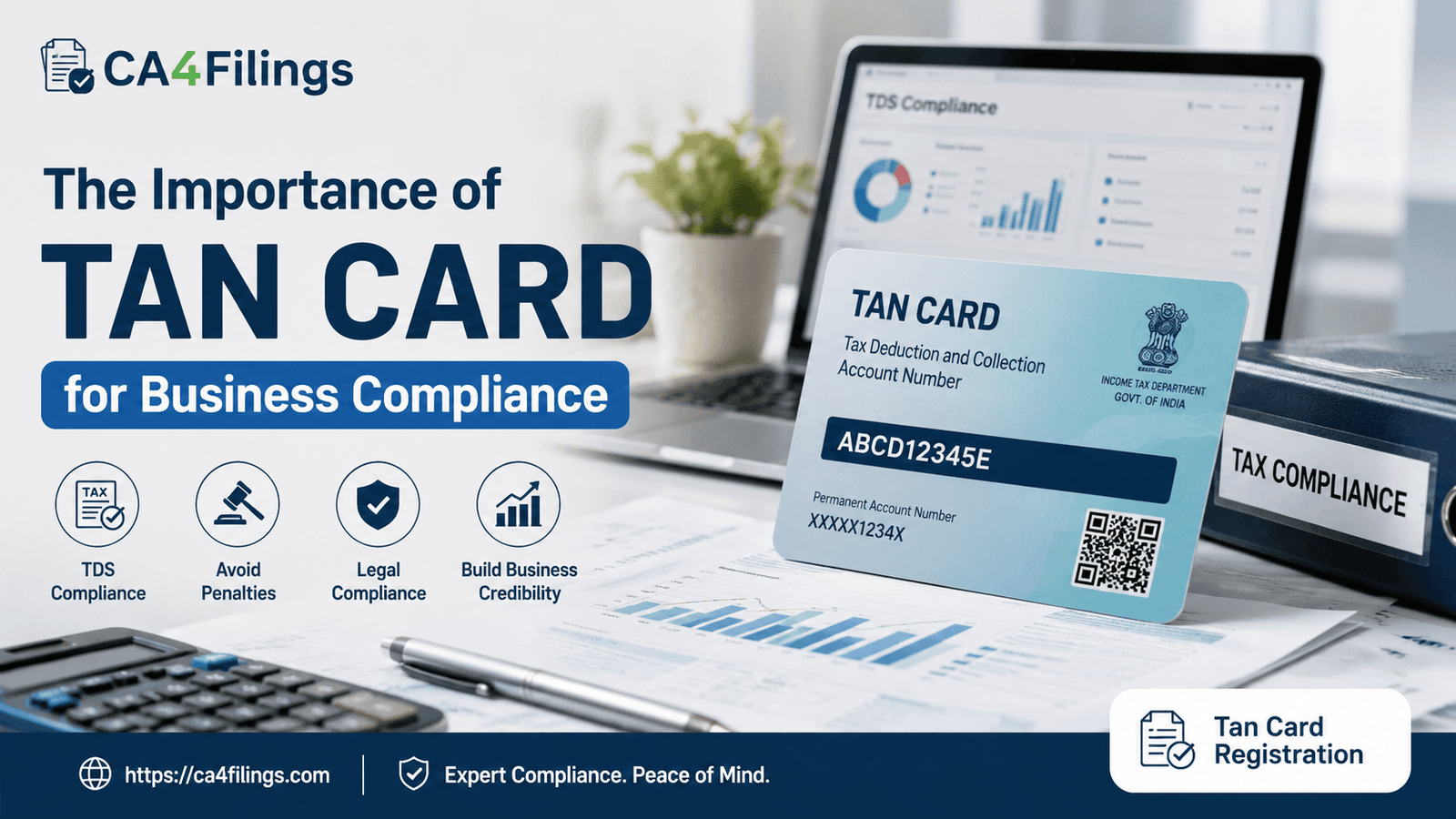
Running a business in India involves much more than sales, operations, and customer management. One of the biggest responsibilities for any business owner is staying compliant with tax laws. Among the many tax-related requirements, understanding The Importance of a TAN Card for Business Compliance is extremely crucial for companies, firms, startups, LLPs, proprietorships, and even professionals who deduct tax at source.
A Tax Deduction and Collection Account Number (TAN) is issued by the Income Tax Department and is mandatory for entities responsible for deducting or collecting tax at source. Without a TAN, businesses can face penalties, difficulties in TDS filing, and legal complications.
At CA4Filings, we regularly assist businesses with smooth Tan Card Registration and compliance management to help them avoid unnecessary notices and penalties.
In this article, we will explain The Importance of a TAN Card for Business Compliance, why it matters, who needs it, and how businesses can stay legally compliant.
What is a TAN Card?
TAN stands for Tax Deduction and Collection Account Number. It is a 10-digit alphanumeric number issued under Section 203A of the Income Tax Act, 1961.
Businesses or individuals who are required to deduct TDS (Tax Deducted at Source) or collect TCS (Tax Collected at Source) must obtain a TAN.
Example of TAN Format
A TAN looks like this:
DELX12345A
Where:
- First 4 characters are alphabets
- Next 5 are numbers
- Last character is an alphabet
The TAN is used in:
- TDS returns
- TDS payment challans
- TDS certificates
- Tax compliance documentation
This clearly shows The Importance of a TAN Card for Business Compliance, especially for businesses handling employee salaries, contractor payments, or professional fees.
Why is TAN Mandatory for Businesses?
Many business owners assume that PAN is enough for tax-related activities. However, PAN and TAN serve different purposes.
PAN vs TAN
| PAN | TAN |
|---|---|
| Used for income tax identification | Used for TDS/TCS compliance |
| Mandatory for taxpayers | Mandatory for tax deductors |
| Issued to individuals/businesses | Issued to entities deducting tax |
Under Indian tax law, businesses deducting TDS without TAN may face serious penalties.
This is one of the primary reasons behind The Importance of a TAN Card for Business Compliance.
The Importance of a TAN Card for Business Compliance
1. Ensures Legal Compliance
Businesses deducting TDS are legally required to quote TAN in:
- TDS returns
- TDS challans
- TDS certificates
- Tax-related correspondence
Failure to comply can attract penalties under the Income Tax Act.
For example, if a company deducts TDS on employee salaries but does not possess a TAN, it may receive notices from the department.
This highlights The Importance of a TAN Card for Business Compliance for avoiding legal troubles.
2. Helps in Smooth TDS Filing
Every business deducting TDS must file quarterly TDS returns.
Without TAN:
- TDS returns cannot be filed
- Challans cannot be generated properly
- Tax records become non-compliant
Businesses often face delays in vendor payments and audits when TDS compliance is incomplete.
A valid TAN helps maintain smooth and systematic tax filing procedures.
3. Avoids Heavy Penalties
Non-compliance with TAN provisions can lead to penalties.
Common Penalties
Failure to Obtain TAN
Penalty of Rs. 10,000 under Section 272BB.
Incorrect TAN Quoting
Penalty may apply for incorrect or invalid TAN usage.
Delay in TDS Returns
Late filing fees and interest may be imposed.
Understanding The Importance of a TAN Card for Business Compliance can help businesses avoid unnecessary financial burdens.
4. Builds Business Credibility
A compliant business creates trust among:
- Vendors
- Clients
- Employees
- Government authorities
When businesses issue proper TDS certificates and maintain transparent tax practices, they appear more reliable and professional.
For startups seeking investors or businesses applying for loans, tax compliance plays a major role.
5. Necessary for Employee Salary Processing
Businesses deduct TDS from employee salaries based on income tax slabs.
Without TAN:
- Salary TDS compliance becomes impossible
- Form 16 cannot be issued correctly
- Employees may face tax filing issues
This is another practical example showing The Importance of a TAN Card for Business Compliance.
Who Needs a TAN Card?
The following entities generally require TAN if they deduct TDS or collect TCS:
- Private Limited Companies
- LLPs
- Partnership Firms
- Proprietorship Businesses
- Trusts
- NGOs
- Government Offices
- Professionals making specified payments
Common Payments Requiring TDS
- Salaries
- Contractor payments
- Professional fees
- Rent payments
- Commission payments
- Interest payments
If your business falls under these categories, obtaining TAN is not optional.
Situations Where TAN is Not Required
There are limited exceptions where TAN may not be required.
For example:
- Individuals not liable for tax audit making certain personal payments
- Specific transactions exempted under the Income Tax Act
However, businesses should always consult tax professionals before assuming exemption.
At CA4Filings, we advise businesses to verify applicability carefully to avoid compliance risks.
How to Apply for a TAN Card
The TAN application process is straightforward if documents are properly prepared.
Step-by-Step Process
Step 1: Fill Form 49B
Application for TAN is submitted through Form 49B.
Step 2: Submit Required Documents
Typically required:
- PAN card
- Business registration proof
- Address proof
- Identity proof
Step 3: Verification
Application details are verified by authorities.
Step 4: TAN Allotment
Once approved, TAN is issued.
Businesses should ensure accurate details to avoid rejection or correction procedures.
Common Mistakes Businesses Make
Even experienced business owners sometimes overlook compliance details.
Frequent Errors Include:
- Delayed TAN application
- Incorrect TAN quoting
- Missing TDS filing deadlines
- Deducting incorrect TDS amounts
- Non-issuance of TDS certificates
These mistakes can result in penalties and notices from the Income Tax Department.
Understanding The Importance of a TAN Card for Business Compliance helps businesses avoid such operational issues.
Practical Example of TAN Compliance
Suppose a marketing company hires freelancers and pays them professional fees exceeding the threshold limit.
The company must:
- Deduct TDS
- Deposit TDS with the government
- File TDS returns
- Issue TDS certificates
Without TAN, none of these processes can be completed properly.
This real-world example demonstrates The Importance of a TAN Card for Business Compliance in day-to-day operations.
Benefits of Timely TAN Registration
Better Compliance Management
Businesses maintain organized tax records.
Faster Vendor Transactions
Vendors often prefer businesses with proper TDS compliance.
Reduced Risk of Notices
Accurate filings minimize tax scrutiny.
Professional Reputation
Compliant businesses gain more trust in the market.
FAQs
Is TAN mandatory for all businesses?
No. TAN is mandatory only for entities required to deduct or collect tax at source.
Can a business have multiple TAN numbers?
Generally, one TAN per business location or deductor is used unless separate branches require different TANs.
What is the penalty for not obtaining TAN?
A penalty of Rs. 10,000 may be imposed under Section 272BB.
Is TAN different from PAN?
Yes. PAN identifies taxpayers, while TAN is specifically for TDS/TCS compliance.
How long does TAN registration take?
Usually, TAN allotment takes a few working days if documents are correctly submitted.
There is no doubt about The Importance of a TAN Card for Business Compliance in India’s tax system. Whether you run a startup, small business, LLP, or established company, TAN plays a critical role in maintaining proper TDS compliance and avoiding penalties.
Businesses that ignore TAN requirements often face tax notices, delayed filings, and operational complications. On the other hand, timely compliance improves credibility, simplifies tax management, and ensures smoother business operations.
At CA4Filings, we help businesses complete TAN registration, manage TDS compliance, and stay updated with changing tax regulations. Our expert team ensures a hassle-free process so you can focus on growing your business while we handle the compliance part professionally.
Latest Updates
ca4filings.com Services



























-registration.png)