Best Strategies for Businesses to Prevent GST Cancellation
Best Strategies for Businesses to Prevent GST Cancellation and ensure smooth GST compliance, timely filing, and uninterrupted business operations.
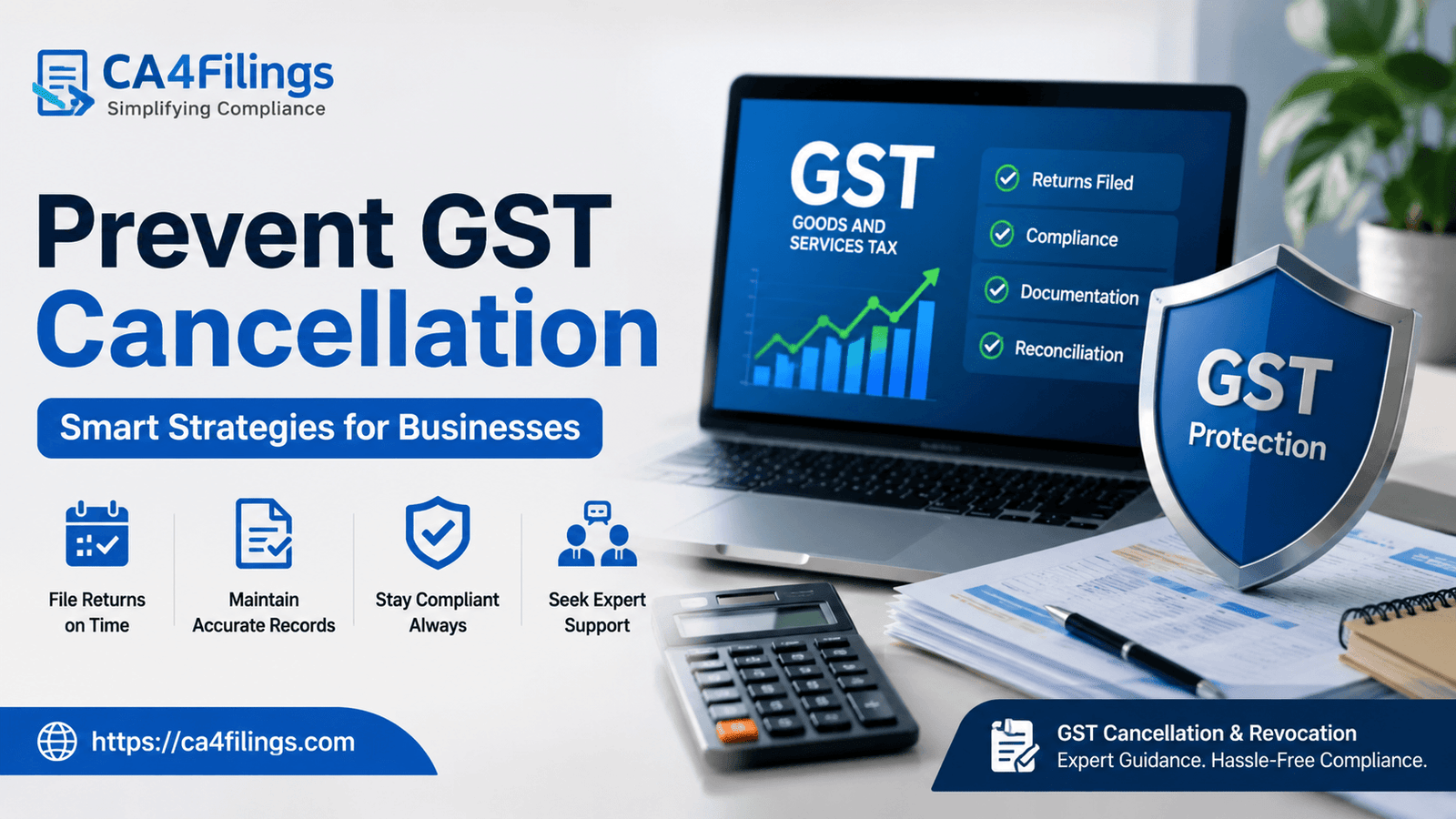
GST registration is one of the most important legal requirements for businesses operating in India. However, many businesses unknowingly make compliance mistakes that lead to GST cancellation notices from the department. Once a GST registration is cancelled, businesses may face severe consequences such as penalties, loss of input tax credit, and disruption in operations.
At CA4Filings, we regularly help businesses handle GST-related compliance issues and guide them through GST Cancellation & Revocation procedures. In our experience, prevention is always better than dealing with cancellation after the damage is done.
This article explains the Best Strategies for Businesses to Prevent GST Cancellation in a practical and easy-to-understand manner so that business owners can stay compliant and avoid unnecessary legal trouble.
Why GST Registration Gets Cancelled
Before discussing the Best Strategies for Businesses to Prevent GST Cancellation, it is important to understand the common reasons behind cancellation.
The GST department may cancel registration due to:
- Non-filing of GST returns for continuous periods
- Incorrect business information
- Issuing fake invoices
- Non-commencement of business after registration
- Violation of GST provisions
- Mismatch in GST records
- Failure to respond to GST notices
- Fraudulent transactions
Many small and medium businesses receive cancellation notices simply because of poor compliance management.
Best Strategies for Businesses to Prevent GST Cancellation
File GST Returns on Time Without Fail
One of the most effective Best Strategies for Businesses to Prevent GST Cancellation is timely GST return filing.
Businesses often ignore nil returns or delay filing due to temporary business slowdowns. However, GST law requires registered taxpayers to file returns even when there is no business activity.
Important returns include:
- GSTR-1
- GSTR-3B
- Annual Return (GSTR-9)
- CMP-08 for composition dealers
Practical Tip
Set automated reminders or hire professional GST consultants to monitor filing deadlines regularly.
Real-World Example
A Delhi-based trader failed to file GSTR-3B for six months because business was temporarily closed. The GST department automatically initiated cancellation proceedings. Timely filing of nil returns could have prevented the issue completely.
Maintain Accurate Business Information
Another important part of the Best Strategies for Businesses to Prevent GST Cancellation is keeping business details updated on the GST portal.
Businesses must promptly update:
- Change in address
- Mobile number
- Email ID
- Nature of business
- Additional place of business
- Bank account details
Incorrect or outdated information can trigger departmental verification and possible cancellation.
Respond to GST Notices Immediately
Ignoring GST notices is one of the biggest mistakes businesses make.
If the GST department issues a show-cause notice regarding non-compliance, businesses should respond within the specified timeline.
Common Notices Include
- Return filing defaults
- Mismatch in invoices
- Verification notices
- Suspicious transaction alerts
Professional consultation at the early stage can prevent escalation.
Reconcile GST Data Regularly
Regular reconciliation is among the Best Strategies for Businesses to Prevent GST Cancellation because mismatches can create compliance red flags.
Businesses should reconcile:
- GSTR-1 with GSTR-3B
- Purchase records with GSTR-2B
- E-invoices with GST returns
- Books of accounts with GST filings
Monthly reconciliation helps identify errors before the department notices them.
Avoid Fake or Incorrect Invoicing
The GST department has become extremely strict regarding fake invoicing and fraudulent ITC claims.
Businesses must ensure:
- Genuine tax invoices
- Correct HSN/SAC codes
- Proper GST rates
- Actual supply of goods/services
- Valid supplier details
Using fake invoices can lead not only to cancellation but also heavy penalties and prosecution.
Importance of Proper Documentation
Proper documentation plays a major role in the Best Strategies for Businesses to Prevent GST Cancellation.
Businesses should maintain:
- Tax invoices
- E-way bills
- Purchase records
- Bank statements
- Vendor agreements
- Stock records
Well-maintained records help businesses defend themselves during departmental scrutiny.
Digital Record Management Helps
Using accounting software and cloud-based record systems can reduce compliance risks significantly.
Popular software options include:
- Tally Prime
- Zoho Books
- Busy Accounting
- QuickBooks
These tools help automate GST compliance and minimize human errors.
Monitor Vendor Compliance
Many businesses overlook vendor compliance, which can indirectly affect their GST registration status.
If vendors are involved in suspicious transactions or fail to file returns regularly, buyers may face ITC mismatches and departmental scrutiny.
Vendor Verification Checklist
Before dealing with suppliers:
- Verify GSTIN status
- Check return filing history
- Confirm business authenticity
- Match invoice details properly
Vendor due diligence is one of the overlooked yet effective Best Strategies for Businesses to Prevent GST Cancellation.
Conduct Internal GST Audits
Regular GST audits help businesses identify risks early.
Benefits of Internal GST Audits
- Detect filing mistakes
- Identify ITC mismatches
- Correct invoice errors
- Improve compliance systems
- Reduce departmental notices
At CA4Filings, we recommend quarterly GST reviews for growing businesses.
Train Employees on GST Compliance
Human errors are a common reason behind GST issues.
Businesses should train accounting and billing teams regarding:
- Invoice preparation
- GST rates
- Return filing
- Documentation
- E-way bill generation
Even small mistakes in invoice entries can create compliance complications.
Use Professional GST Support
Many business owners try to manage GST compliance independently but later face notices due to technical errors.
Professional CA guidance helps businesses:
- Stay updated with GST law changes
- Handle notices properly
- Maintain accurate compliance
- Reduce cancellation risk
Seeking expert support is one of the smartest Best Strategies for Businesses to Prevent GST Cancellation, especially for businesses with high transaction volumes.
Consequences of GST Cancellation
Understanding the consequences helps businesses take compliance seriously.
Business Problems After GST Cancellation
- Loss of legal authority to collect GST
- Input tax credit blockage
- Penalties and late fees
- Business reputation damage
- Difficulty in dealing with vendors
- Banking and tender participation issues
In many cases, restoring cancelled registration becomes time-consuming and expensive.
Steps to Take If You Receive a GST Cancellation Notice
Even compliant businesses may occasionally receive notices.
Immediate Actions to Take
Step 1: Read the Notice Carefully
Understand the reason mentioned by the GST officer.
Step 2: Check the Due Date
Respond within the prescribed timeline.
Step 3: Gather Supporting Documents
Prepare returns, invoices, reconciliation reports, and explanations.
Step 4: File Proper Reply
Submit a legally correct response on the GST portal.
Step 5: Seek Professional Assistance
Expert representation improves the chances of avoiding cancellation.
FAQs
What is the most common reason for GST cancellation?
The most common reason is continuous non-filing of GST returns.
Can GST registration be restored after cancellation?
Yes, businesses can apply for revocation of cancellation within the prescribed time limit if eligible.
Is filing nil GST return mandatory?
Yes, nil returns must also be filed even if there is no business activity.
How often should GST reconciliation be done?
Ideally, businesses should perform reconciliation every month.
Can wrong invoices lead to GST cancellation?
Yes, fake or incorrect invoicing can result in cancellation, penalties, and legal action.
Maintaining GST compliance is not just a legal requirement—it is essential for smooth business operations and long-term credibility. The Best Strategies for Businesses to Prevent GST Cancellation mainly involve timely return filing, proper documentation, accurate reconciliation, employee training, and professional compliance management.
Businesses that proactively manage GST compliance rarely face cancellation issues. On the other hand, negligence, delayed filings, and poor record management can quickly attract departmental action.
At CA4Filings, we help businesses stay fully compliant with GST regulations and provide expert assistance for notices, compliance management, cancellation handling, and revocation services. If you want to safeguard your GST registration and avoid unnecessary legal complications, connect with CA4Filings today for reliable professional support.
Latest Updates
ca4filings.com Services

























-registration.png)