Drafting the Perfect Objects Clause for Your Register Private Limited Company Filing
Learn how to draft a clear objects clause when you register private limited company in India, with practical tips, legal guidance and expert advice.
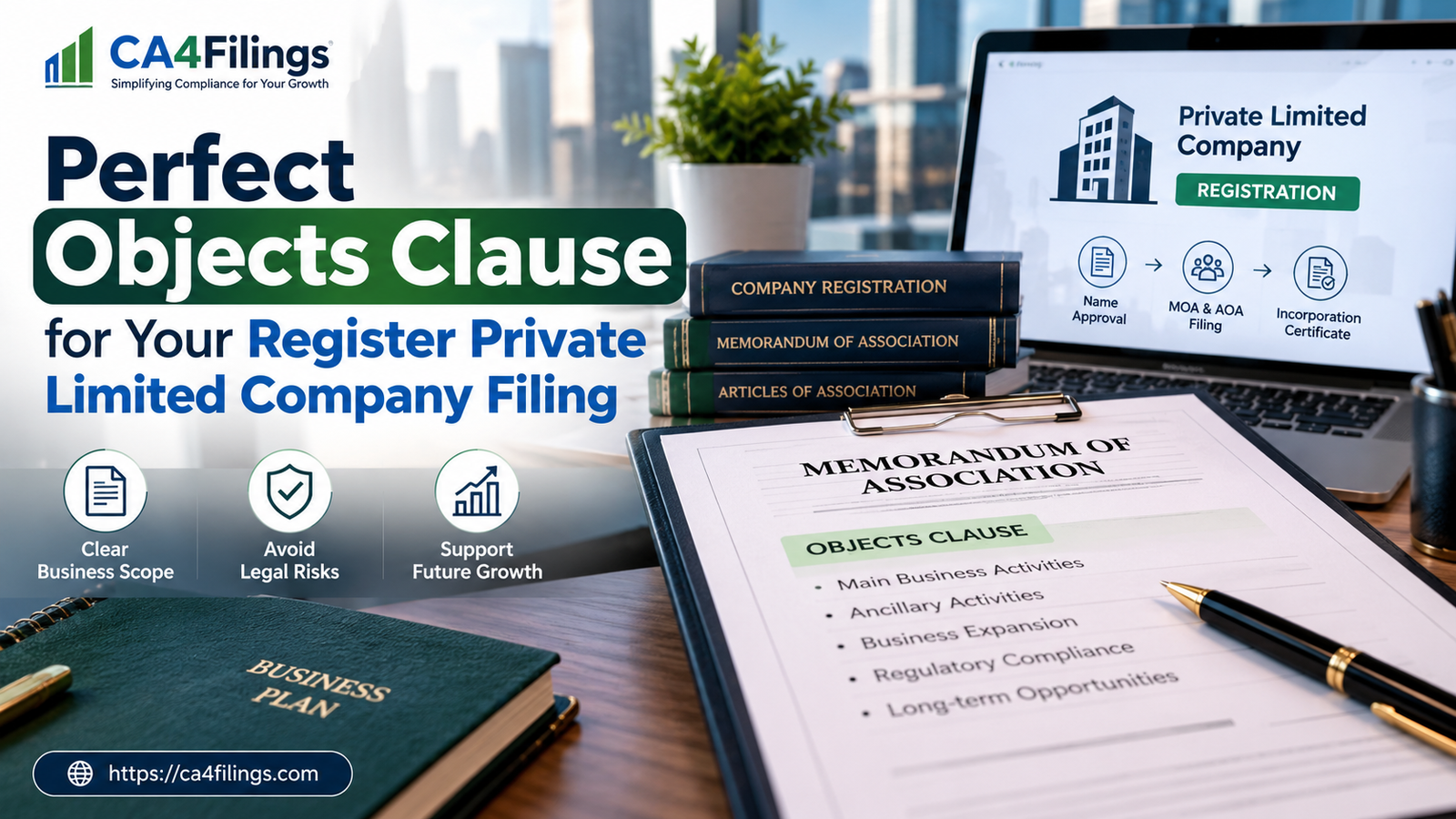
When entrepreneurs decide to register private limited company in India, they often focus on the company name, directors, capital and incorporation documents. However, one important element that deserves equal attention is the objects clause. It defines the activities the company is established to undertake and provides a legal framework for its business operations.
At CA4Filings, we regularly guide entrepreneurs through the incorporation process and explain how a well-drafted objects clause can support their long-term business plans. Whether you are launching a technology startup, a consultancy firm or a manufacturing business, understanding this clause is essential. Our Company Registration services help business owners navigate incorporation requirements while preparing the necessary documentation.
A carefully drafted objects clause can reduce future compliance complications, support business expansion and help the company maintain clarity about its permitted activities. Let us understand how to draft one effectively.
What Is an Objects Clause in the Memorandum of Association?
The objects clause forms part of the memorandum of association (MOA), a foundational document that outlines the company's purpose and key legal details.
Under Section 4 of the Companies Act, 2013, the memorandum must state the objects for which the company is proposed to be incorporated and matters considered necessary in furtherance of those objects.
In simple terms, it explains what the company intends to do and which activities are connected to achieving its business purpose.
For example, a company established to provide digital marketing services may include activities such as search engine optimisation, website development, online advertising and marketing consultancy.
These activities establish the company's operational spectrum and provide clarity to directors, shareholders, regulators and other stakeholders.
Why You Should Draft the Objects Clause Carefully
When you register private limited company, the objects clause should reflect both your immediate business requirements and realistic future plans.
1. Establish Clear Business Boundaries
A properly drafted clause defines the company's business boundaries and helps directors understand the activities covered by its stated objectives.
Vague descriptions may create uncertainty, while overly restrictive clauses can make future diversification more complicated.
For instance, an IT services company that intends to develop software products should consider including software development, licensing and related technology services instead of limiting its objects exclusively to IT consultancy.
2. Reduce the Risk of Ultra Vires Acts
Ultra vires acts are activities undertaken beyond the company's legal powers or stated objects.
Although the Companies Act, 2013 provides a framework for defining company objects, businesses should ensure their proposed activities align with the memorandum and applicable laws.
A transaction outside the company's stated objects may create legal and governance concerns. Depending on the circumstances, it may affect contractual arrangements, director responsibilities and shareholder interests.
A well-considered objects clause helps reduce these risks.
3. Support Future Business Expansion
Business plans often evolve after incorporation. A startup may initially offer consulting services before launching digital products or entering related markets.
Including reasonably anticipated activities and legitimate ancillary activities can provide greater flexibility without making the clause unnecessarily broad.
The objective is to create a practical balance between present operations and future opportunities.
How to Draft the Perfect Objects Clause When You Register Private Limited Company
Follow these practical steps before finalising your MOA.
Step 1: Identify the Company's Main Business Activity
Start by defining the primary purpose of the company in clear, specific language.
Ask yourself:
What products will the company manufacture or sell?
Which services will it provide?
Who are its intended customers?
What problem will the business solve?
How does the company plan to generate revenue?
For example, a company selling eco-friendly packaging products may identify manufacturing, processing, marketing and distribution of sustainable packaging materials as its principal objects.
A clearly defined primary activity gives the rest of the clause a logical foundation.
Step 2: Include Relevant Ancillary Activities
Ancillary activities are supporting activities that help the company carry out its main business.
Depending on the business model, these may include:
Purchasing, leasing or maintaining equipment.
Hiring employees, consultants and technical experts.
Marketing and promoting products or services.
Acquiring or licensing intellectual property.
Establishing offices, warehouses or distribution networks.
Entering into lawful commercial arrangements connected with the main business.
These provisions should have a genuine connection with the company's principal objects. Avoid adding unrelated activities simply because they might become commercially attractive in the future.
Step 3: Use Clear and Legally Appropriate Language
When you register private limited company, the objects clause should be professionally drafted without unnecessary complexity.
Avoid vague expressions such as "to conduct all kinds of business" or "to undertake any activity whatsoever." Such wording may fail to communicate the company's intended purpose clearly.
Instead, describe the relevant activities in practical terms.
For example, rather than writing "to provide technology-related services," consider specifying software development, website design, application development, IT consultancy and software maintenance, where these reflect the actual business plan.
Step 4: Consider the Operational Spectrum
Think beyond the first product or service you intend to launch.
If you are establishing an e-commerce business, your operational spectrum might include online retail, product sourcing, inventory management, digital marketing, order fulfilment and distribution.
However, the objects clause should not be treated as permission to undertake every activity listed. Sector-specific licences, regulatory approvals and other statutory requirements may still apply.
Step 5: Review the Clause Before Filing
Before submitting incorporation documents, check that:
The principal objects accurately reflect the proposed business.
Supporting activities are reasonably connected to those objects.
The language is specific, understandable and consistent.
Regulated activities are identified and reviewed separately.
The clause aligns with the company's actual business plans.
Professional review at this stage can help prevent avoidable corrections and amendments later.
Common Mistakes to Avoid While Drafting the Objects Clause
Entrepreneurs preparing to register private limited company should watch out for the following mistakes.
Using excessively broad wording: Generic descriptions may weaken the clarity of the company's purpose.
Copying another company's MOA: A clause suitable for a manufacturing business may not suit a fintech startup or consultancy firm.
Ignoring future requirements: Restricting the objects to a single narrow service can create difficulties when the business expands into closely related areas.
Including unrelated activities: Adding numerous disconnected objects may create unnecessary complexity and regulatory questions.
Overlooking licensing requirements: Stating an activity in the MOA does not replace any mandatory licence, registration or approval.
Neglecting amendment procedures: If the business later changes direction, the company may need to alter its objects clause through the applicable legal process.
Can You Change the Objects Clause After Incorporation?
Yes. A company can alter its objects clause after incorporation, subject to the Companies Act, 2013 and applicable procedural requirements.
Generally, the process involves:
Reviewing the proposed change and its business justification.
Convening the appropriate board meeting.
Obtaining shareholder approval through a special resolution.
Filing the relevant resolution and prescribed forms with the Registrar of Companies, as applicable.
Completing any additional requirements relevant to the company's circumstances.
For a typical alteration of objects, the company should examine Section 13 of the Companies Act, 2013, the applicable rules and current MCA filing requirements.
The exact procedure may depend on the nature of the change and other facts, including whether the company has raised funds from the public through a prospectus and has unutilised amounts from that issue.
Seeking professional advice before making changes can help ensure that the company follows the correct procedure.
Latest Updates
ca4filings.com Services

































